
Choosing a UPS feels complicated by battery options. Making the wrong choice leads to high costs and poor performance, undermining the very reliability you seek.
The two main types of UPS batteries are Valve-Regulated Lead-Acid (VRLA)1 and Lithium-ion. VRLA is the traditional, cost-effective choice, while modern Lithium-ion2 offers a longer life, smaller size, and superior performance for a lower total cost of ownership.
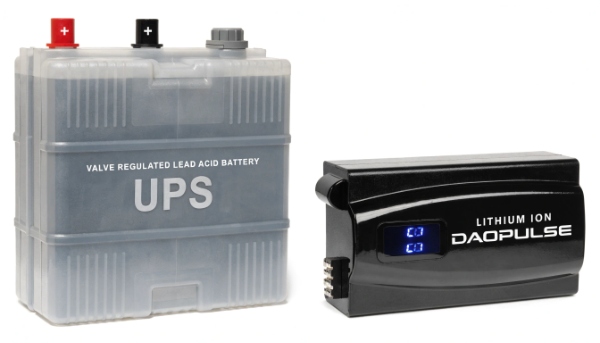
As a manufacturer, I've spent over a decade guiding clients through this decision. The battery is the heart of the UPS, and the choice between lead-acid and lithium-ion is a strategic one. It impacts not just your immediate budget, but your operational costs, physical space, and maintenance workload3 for the next decade. This isn't just about technical specs; it's about finding the right long-term solution for your business. Let's break down what that means for you.
How Long Does a UPS Battery Typically Last?
You expect your UPS to work during an outage, but its battery life4 is a ticking clock. An unexpected battery failure can cause the exact downtime you wanted to prevent.
A standard lead-acid UPS battery typically lasts 3 to 5 years. In contrast, a lithium-ion battery in a UPS can last 10 to 15 years. These are estimates, as real-world lifespan is heavily influenced by operating conditions.
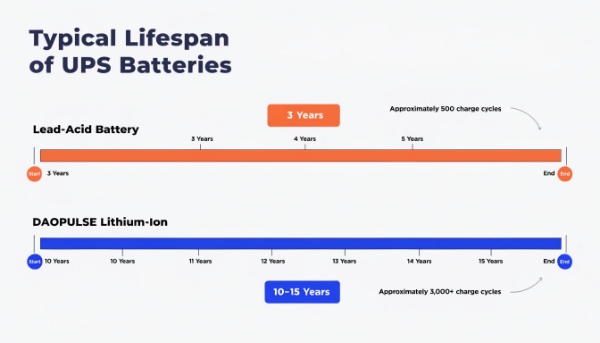
The Factors That Decide Your Battery's True Lifespan
In my experience, the number on the box is just a starting point. Several factors determine how long your UPS battery will actually last. First is the load. A UPS running at 90% capacity will wear out its battery much faster than one running at 60%. Second is the environment. For lead-acid batteries, heat is the enemy. For every 8°C rise in temperature above 25°C, the battery's life can be cut in half. A third factor is your grid quality. If you have frequent power sags or short outages, your battery works more often and will wear out faster. My insight is that you can't just trust the calendar. You need to check the battery's health. A key test we use is to check the voltage after a full 24-hour charge. If the voltage is below 10.5V or 11V, it's a strong sign the battery needs replacement. This is especially true if the UPS is over a year old. A low voltage means it can't hold a proper charge and won't deliver the runtime you expect when you need it most.
What Is the Difference Between Lithium-Ion and Lead-Acid UPS Batteries?
You see "lead-acid" and "lithium-ion" on spec sheets, with a big price difference. The real-world impact of this choice on your business isn't always clear.
Lithium-ion batteries are lighter, smaller, last 2-3 times longer, and are more efficient. Lead-acid batteries have a lower upfront cost and are heavier and larger, making them the traditional, budget-friendly choice for some applications.
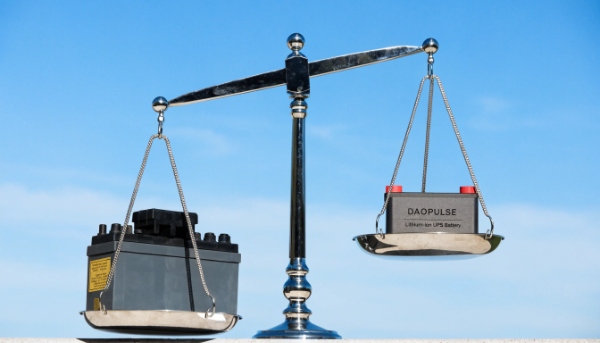
Comparing the Old Standard to the New
As a procurement manager or system integrator, the choice between these two technologies comes down to a few key differences that impact your total cost of ownership (TCO). Let's put them side-by-side.
| Feature | Traditional Lead-Acid | DAOPULSE Lithium-Ion |
|---|---|---|
| Upfront Cost | Lower | Higher |
| Lifespan | 3-5 years | 10-15 years |
| Replacements | 2-3 cycles in 10 years | 0-1 cycles in 10 years |
| Weight & Size | Heavy & Large | Up to 60% Lighter & Smaller |
| Efficiency | ~85% | ~97% |
| Maintenance | Regular checks needed | Virtually zero |
| Total Cost of Ownership | Higher | Lower |
The higher initial cost of lithium-ion can be a hurdle. But when you factor in that you won't have to buy replacement batteries or pay for labor to install them every few years, the math changes. Add the energy savings5 from higher efficiency and reduced cooling needs, and the lithium-ion solution often proves to be the cheaper option over its lifetime. It frees up rack space, reduces structural load, and gives you back valuable man-hours previously spent on maintenance.
How Do You Maintain a UPS Battery for Optimal Performance?
You bought a UPS for peace of mind, but neglect can lead to failure. Maintenance feels like a chore, but skipping it is a risk that could cost you dearly.
For lead-acid, perform regular visual inspections and keep the unit cool. For lithium-ion, maintenance is minimal thanks to the internal Battery Management System (BMS)6. For both, a periodic runtime test is the best way to ensure readiness.

Simple Steps for Long-Term Reliability
A UPS is not a "set it and forget it" device, but maintenance doesn't have to be difficult. Following a few simple rules will maximize your battery's life and ensure the UPS works when you need it.
1. Control the Temperature
This is the most important rule, especially for lead-acid batteries. A cool, dry location is ideal. High ambient heat will drastically shorten the service life of the battery.
2. Perform Visual Inspections
About once every quarter, take a look at your battery bank (if it's lead-acid). You are looking for any signs of trouble, such as swelling or bloating of the battery case, any leaking fluid, or any corrosion building up on the terminals. These are clear signs that a battery is failing and needs to be replaced immediately.
3. Don't Fear the Test
Most UPS units have a self-test function7. Run this every six months. More importantly, once a year, perform a real-world test. Unplug the UPS from the wall and let it run on battery for a few minutes while powering a non-critical load. This will confirm the battery can still hold a charge and give you a realistic idea of the runtime. This simple test is the best way to build confidence in your backup power system.
Are UPS Battery Systems Environmentally Friendly?
You need reliable power, but you're also concerned about e-waste and environmental impact8. UPS batteries look like a big, heavy contributor to the problem.
Both battery types have environmental impact8s, but they are highly recyclable. Lead-acid batteries have a mature recycling program with a recovery rate over 99%. Lithium-ion's longer life reduces waste, and its recycling infrastructure is rapidly growing.
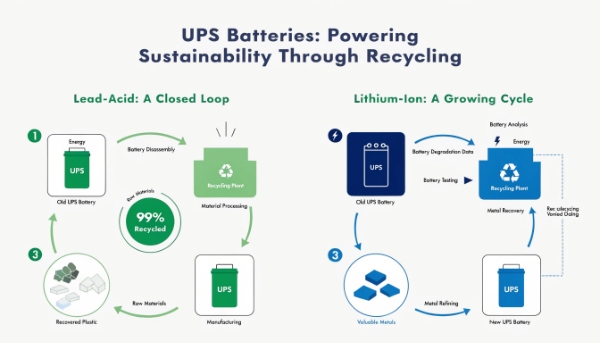
A Look at the Lifecycle
The environmental question is important, and it's something we take seriously as a manufacturer. It's helpful to look at the entire lifecycle of the product.
The Lead-Acid Recycling Success Story
Lead-acid batteries are an amazing recycling success. The system is a closed loop. When you replace an old battery, it goes to a recycler where over 99% of its materials are recovered. The lead is melted down and used in new batteries, the plastic case is turned into new cases, and even the sulfuric acid can be reused. It's one of the most successfully recycled products on the planet.
The Lithium-Ion Efficiency Argument
The primary environmental benefit of lithium-ion is its long life and high efficiency. Over a 15-year period, you might use one lithium-ion battery set or three to four lead-acid sets. This means less manufacturing, less shipping, and less waste generated overall. Their higher operating efficiency also means less electricity is wasted over their lifetime. While lithium recycling is more complex, the industry is scaling up quickly, driven by the electric vehicle market, and we design our packs to be ready for this future.
Conclusion
Choosing the right UPS battery, whether lead-acid or lithium-ion, involves balancing cost, performance, and maintenance. Understanding these factors ensures you make a smart, long-term investment in your power reliability.
-
Explore the benefits of VRLA batteries, including cost-effectiveness and reliability for your UPS needs. ↩
-
Discover why Lithium-ion batteries are becoming the preferred choice for UPS systems due to their longevity and efficiency. ↩
-
Understand the differences in maintenance requirements between lead-acid and lithium-ion batteries for better planning. ↩
-
Understand the key factors that influence UPS battery life to optimize your power backup solutions. ↩
-
Learn how efficient UPS systems can lead to significant energy savings and lower operational costs. ↩
-
Learn about the critical role of BMS in enhancing the performance and safety of lithium-ion UPS batteries. ↩
-
Learn how to effectively use the self-test function to ensure your UPS is ready for power outages. ↩
-
Explore the environmental implications of UPS batteries and how recycling can mitigate their impact. ↩ ↩