
You're told lithium UPS technology is superior, but now you hear about failures in different countries. This creates doubt about its reliability for your critical infrastructure projects.
Yes, lithium UPS failures are reported globally, but they are not due to the core technology. These failures are consistently traced back to a poorly designed Battery Management System (BMS) that is not built to handle local environmental challenges like voltage surges, humidity, or extreme heat.

These reports tell a story of engineering that falls short, not of faulty lithium chemistry. As an OEM/ODM manufacturer with a decade of experience, we have analyzed these issues in depth. Let's break down these specific failure cases from three continents to see what is really going on and how to avoid these problems in your own projects.
Is Your Lithium UPS a Ticking Bomb?
You invest in a lithium UPS for its promised safety and long life. But news of fires and system failures makes you worry that you might be installing a dangerous hazard instead.
A high-quality lithium UPS is extremely safe, not a ticking bomb. Catastrophic failures are almost always caused by a cheap, poorly engineered Battery Management System (BMS) that fails to control thermal runaway, overcharging, or cell imbalances. A robust BMS is the key to safety.
The Role of a Quality BMS
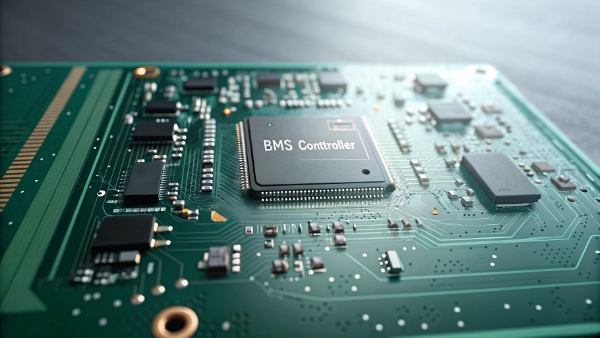
I've seen firsthand what happens when a BMS fails. The BMS is the brain of the battery pack. Its job is to monitor every cell and ensure the entire system operates within safe limits. A cheap, off-the-shelf BMS might only watch the total pack voltage. But a properly designed one, like the ones we build, monitors the voltage and temperature of individual cells. This is critical. If one cell starts to overheat or overcharge, a good BMS will isolate it or shut the system down safely long before it becomes a danger. This granular level of control is what separates a safe, reliable system from a potential fire hazard. A robust BMS is a non-negotiable part of our design philosophy.
| Feature | Low-Quality BMS (High Risk) | High-Quality BMS (Low Risk) |
|---|---|---|
| Monitoring | Pack-level only | Individual cell voltage & temperature |
| Balancing | None or passive only | Active cell balancing |
| Protection | Basic over-voltage fuse | Multi-stage overcharge, over-discharge, short circuit, and thermal protection |
| Origin | Generic, off-the-shelf | Custom-designed for the specific application and cells |
Why UPS BMS Panics During Kenya’s +25% Voltage Surges?
You have a critical installation in a region with an unstable power grid, like Kenya. Your UPS keeps tripping offline during voltage spikes, defeating its entire purpose and causing downtime.
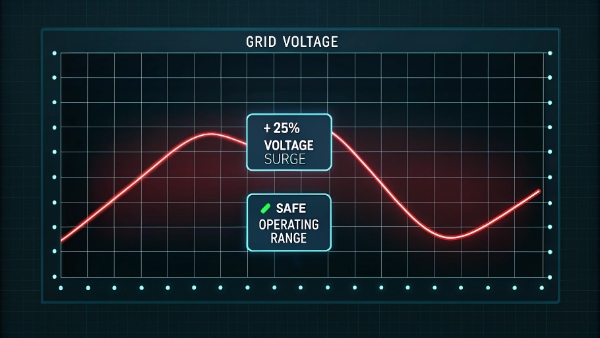
A standard BMS interprets a large voltage surge from the grid as a catastrophic fault. This causes it to "panic" and trigger a protective shutdown to save the battery, even if there's no real danger. The UPS needs to be designed for these conditions.
Designing for Grid Instability
We worked on a project for a hospital in Nairobi where this exact problem occurred with another brand's UPS. The local grid frequently experienced surges up to +25% of the nominal voltage. Their existing UPS systems saw this surge at the charger, and the BMS immediately disconnected the battery pack, causing the whole system to shut down. The problem wasn't the battery; it was a BMS with a very narrow input tolerance. Our solution was to provide a UPS with a BMS and charging system designed specifically for these environments. We use higher voltage-rated components and enhanced surge protection filters. This allows the UPS to ride through the voltage surge without disconnecting the battery, ensuring the protected equipment stays online.
| Design Element | Standard UPS | Our Grid-Hardened UPS |
|---|---|---|
| Input Voltage Tolerance | ±10% to ±15% | ±25% or wider |
| Surge Protection | Basic MOV | Multi-stage with TVS Diodes and Gas Discharge Tubes |
| BMS Logic | Shuts down on any out-of-spec input | Differentiates between a surge and a critical fault |
How 90% Humidity Corrodes UPS Battery Management Chips?
You are managing projects in tropical regions like Southeast Asia. Your UPS units are failing years before their expected end-of-life, and you can't figure out why.
In high-humidity environments, moisture condenses on circuit boards. This moisture, combined with dust, can corrode the delicate electronic chips and traces on the BMS, causing short circuits and complete system failure. The board must be physically protected.

The Silent Killer: Conformal Coating
I remember a client in Singapore who was replacing UPS units every 18 months at a coastal facility. When we opened a failed unit, the BMS board was covered in a fine layer of green and white corrosion. The air's salt and moisture had literally eaten the electronics. The solution is simple but often skipped by manufacturers to save cost: conformal coating. This is a thin, transparent polymer film that we apply to our circuit boards. It acts like a raincoat, completely sealing the sensitive components from moisture, salt, and dust. This single step can extend the life of a UPS in a harsh environment from under two years to its full design life. For any client operating in a tropical or coastal region, we insist on providing units with conformally coated boards. It is a small cost that prevents catastrophic failure.
| Feature | Standard, Unprotected BMS | Our Conformal Coated BMS |
|---|---|---|
| Moisture Resistance | Very Low | Very High |
| Dust/Pollutant Shield | None | Fully sealed components |
| Expected Lifespan (Humid Climate) | 1-2 Years | 5-10 Years |
| Cost | Lower Initial Cost | Higher Reliability & Lower TCO |
Is Lithium Battery Lifespan Fraud in Desert Climates?
You were promised a 10-year lifespan for your new lithium UPS. But in your hot, desert-based data center, the batteries are degrading and need replacement in just two or three years.
It's not fraud, but it is misleading marketing. Battery lifespan ratings are based on a controlled temperature of 25°C (77°F). For every 10°C increase above that, a battery's life is cut roughly in half.

Engineering for High-Temperature Environments
Heat is the number one enemy of any battery. High ambient temperatures, like those in the Middle East, accelerate the chemical reactions inside a lithium cell. This causes permanent capacity loss and shortens its life dramatically. A battery that lasts 10 years in an air-conditioned office in Europe might not last two years in a warehouse in Dubai. As an OEM, our responsibility is to be honest about this. When a client approaches us for a project in a hot climate, we don't just sell them a standard product. We ask about the operating environment. If it's not climate-controlled, we provide solutions. This includes using special high-temperature LiFePO4 cells rated for operation up to 60°C and integrating a more aggressive thermal management system where the BMS actively manages cooling fans to protect the cells. This ensures our clients get the reliability they expect and are not disappointed by a misleading lifespan claim.
| Operating Temperature | Expected Lifespan (from 10-Year baseline) |
|---|---|
| 25°C (77°F) | 10 Years |
| 35°C (95°F) | ~5 Years |
| 45°C (113°F) | ~2.5 Years |
Conclusion
Lithium UPS failures are not about the technology but about poor, one-size-fits-all engineering. A robust, environment-specific design is the only true path to global reliability and long-term project success.