
You've heard about the power of lithium-ion, but also the horror stories. Choosing a lithium UPS feels like a risk, and a fire in your data center is not an option.
DAOPULSE ensures safety through a multi-layered system, including an advanced Battery Management System (BMS), cell-level monitoring, rigorous factory testing, and full compliance with international CE and RoHS certifications. We build safety into the core of our design.
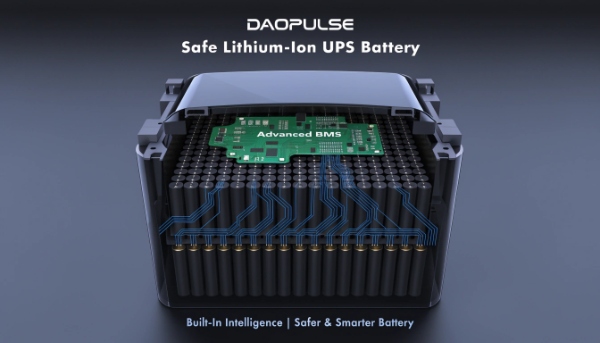
As an OEM/ODM manufacturer for over a decade, I've spoken with hundreds of system integrators and procurement managers. Their primary concern about lithium-ion is always safety. They see the benefits, but the fear of thermal runaway is real. I always tell them that not all lithium-ion systems are created equal. It's the intelligence built around the battery cells that makes all the difference. Our entire design philosophy is built on creating a system that is not just powerful, but also fundamentally safe and reliable. Let's dig into how these systems compare and what makes them a smart upgrade.
Are Lithium-Ion Batteries Really Better Than Traditional Lead-Acid for a UPS?
Your old lead-acid batteries are heavy, need frequent replacement, and take up too much space. This constant maintenance cycle is a drain on your budget and your team's time.
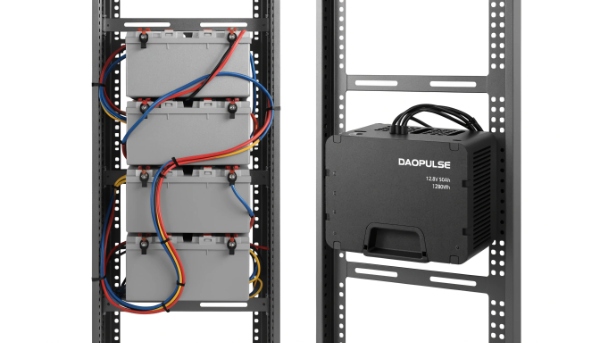
Yes, for most modern applications, lithium-ion is far superior. They last 2-3 times longer, are up to 60% lighter and smaller, and are more efficient. This results in a significantly lower Total Cost of Ownership (TCO).
A Clear Winner in Total Cost of Ownership
When I talk to clients, they often focus on the higher initial purchase price of lithium-ion. That's understandable. But I always encourage them to look at the 10-year picture. The upfront cost is just one part of the story. A lead-acid battery system needs to be replaced every 3-5 years. A lithium-ion system from us can last 10-15 years. Right there, you've eliminated two or three expensive replacement cycles, including the cost of the batteries and the labor to install them. Furthermore, lithium-ion batteries are more efficient, meaning less of your utility power is wasted as heat during charging. They also run cooler, reducing the load on your air conditioning. When you add up all these savings over a decade, the lithium-ion UPS is almost always the more economical choice. It's a classic case of investing a bit more now to save a lot more later.
| Feature | DAOPULSE Lithium-Ion | Traditional Lead-Acid |
|---|---|---|
| Lifespan | 10-15 Years | 3-5 Years |
| Footprint / Weight | Up to 60% smaller & lighter | Bulky & Heavy |
| Maintenance | Virtually zero | Regular monitoring required |
| Efficiency | ~97% | ~85% |
| Upfront Cost | Higher | Lower |
| Total Cost of Ownership | Lower | Higher |
What are the Compelling Reasons to Switch to a DAOPULSE Lithium-Ion UPS?
You know lithium-ion is the future, but you need solid business reasons to justify the upgrade. Sticking with old technology means higher operational costs and falling behind your competitors.
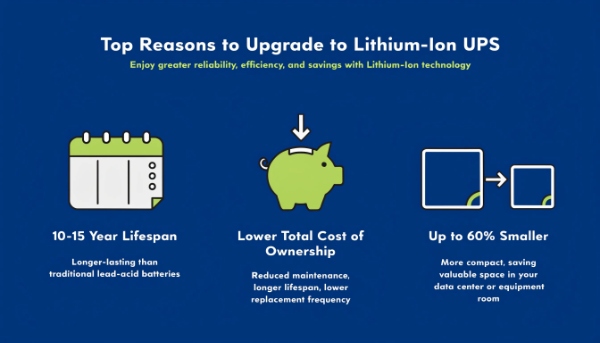
The switch is justified by a lower Total Cost of Ownership, a 2-3x longer lifespan, a smaller physical footprint, and far greater reliability. It's an investment in long-term operational and financial efficiency.
Beyond a Simple Battery Swap
Moving to a DAOPULSE lithium-ion UPS is a strategic upgrade for your facility. The benefits go beyond just longer life and create a strong business case for any procurement manager.
Financial Benefits
The most compelling reason is the dramatic reduction in TCO. Think about it: no battery replacements for over a decade. No maintenance calls to check water levels or clean terminals. Lower electricity bills because the UPS runs more efficiently and requires less cooling. I worked with a data center manager who calculated that the reduced cooling costs alone would pay back the price difference in just four years.
Operational Advantages
Space is money, especially in a data center. Our lithium-ion solutions can free up valuable rack space for more IT equipment. Their lighter weight also makes installation easier, faster, and safer, often reducing the need for reinforced flooring or extra personnel. Plus, they recharge much faster than lead-acid, meaning your facility is back to full protection sooner after an outage.
Enhanced Reliability and Safety
This is where the built-in intelligence shines. Our advanced Battery Management System (BMS) monitors every cell individually. It actively balances the charge and prevents over-voltage or deep discharge. A lead-acid battery often fails silently and catastrophically. Our lithium systems give you advanced warnings, so you can address issues long before they become critical failures.
How Do DAOPULSE Lithium-Ion UPS Systems Revolutionize Data Center Energy Efficiency?
Your data center energy costs are climbing, driven by power and cooling expenses. Your Power Usage Effectiveness (PUE) is too high, eating into profits and hurting your green credentials.
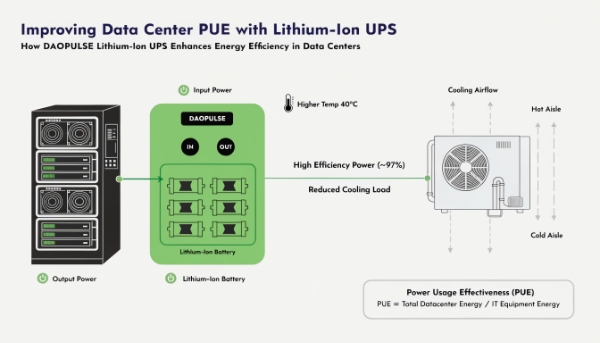
Our lithium-ion UPS systems attack high PUE in two ways. They have higher electrical efficiency, wasting less power. They also operate safely at higher temperatures, dramatically cutting your expensive air conditioning costs.
A Two-Pronged Attack on Energy Waste
For my clients in the data center industry, PUE is everything. It's the measure of their efficiency. A traditional UPS system is often a major source of inefficiency, but our lithium-ion solutions directly address this.
Higher Round-Trip Efficiency
First, the battery chemistry itself is more efficient. For every 100 kWh of electricity you use to charge a lead-acid battery, you might only get 85 kWh back out. That's a 15% loss. With our lithium-ion systems, that number is closer to 97%. You get 97 kWh back for every 100 kWh you put in. That 12% difference is a direct, 24/7 saving on your utility bill.
Higher Operating Temperature
Second, and perhaps more importantly, is temperature. Lead-acid batteries must be kept in a cool room, around 20-25°C (68-77°F), to reach their advertised lifespan. Cooling is one of the biggest energy hogs in a data center. Our lithium-ion batteries are designed to operate safely and effectively at much higher ambient temperatures—up to 40°C (104°F). This allows you to raise the thermostat in your data center, significantly reducing the load on your cooling systems. Every degree you raise the temperature can cut cooling costs by 4-5%. This is a game-changer for reducing PUE and operational expenses.
What Are the Critical Installation Considerations for DAOPULSE Lithium-Ion UPS?
You're ready to upgrade to a lithium-ion UPS, but you're concerned about installation. You know it's not a simple swap, and a mistake could introduce new risks or damage the equipment.
Critical steps include ensuring the UPS is configured for lithium-ion charging profiles, properly connecting the Battery Management System (BMS) for communication, and leveraging the lighter weight for a simpler, faster physical installation.
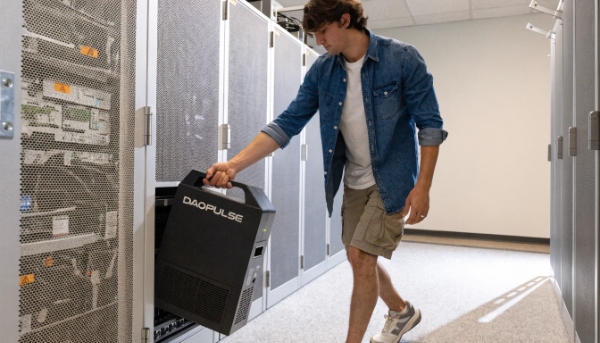
Planning for a Smooth Transition
When we work with system integrators on a new project, we make the installation process as seamless as possible. While lithium-ion is a different technology, we've designed our systems to make the transition straightforward and safe.
Firmware and Charging Profiles
You cannot simply connect a lithium-ion battery to a UPS designed for lead-acid. The charging requirements are different. Our DAOPULSE UPS units are built with flexible firmware. During setup, the installer simply selects the "Lithium-Ion" profile. This tells the UPS to use the correct charging algorithm, protecting the battery, ensuring its long life, and maintaining safety.
The Brains of the Operation: The BMS
The Battery Management System1 is the heart of the battery's safety. During installation, it's crucial that the communication cable between the BMS and the UPS is connected correctly. This allows the UPS to see detailed data from the battery—like voltage, temperature, and state of charge for every cell—and respond instantly to any irregularity. It’s a simple plug-in connection, but it’s the most important one.
Physical and Logistical Advantages
Finally, the installation itself is physically easier. I've seen teams struggle with heavy lead-acid batteries, needing special lifts and multiple people. Our lithium modules are often light enough for one person to handle. This speeds up deployment, reduces labor costs, and makes the whole process safer for the installation crew.
Conclusion
DAOPULSE lithium-ion UPS systems2 offer a safe, reliable, and financially sound upgrade over old technology. They provide long-term value through superior efficiency, a longer lifespan, and a much lower TCO.