Skip to content
You've invested in a UPS, but its performance seems unpredictable. Inefficient batteries waste money and risk failure, leaving you vulnerable when you need power most.
UPS battery efficiency1 is mainly affected by load level, ambient temperature, battery age, and charge/discharge cycles. Operating at 75% load and in a cool environment (around 25°C) typically yields the best performance.
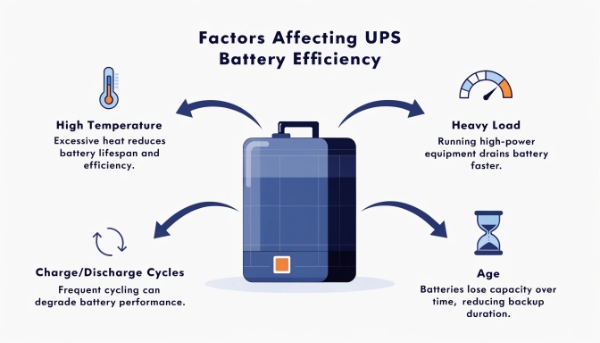
I've worked with hundreds of procurement managers over the last decade. A common mistake I see is focusing only on the purchase price. But the true cost of a UPS is tied to its long-term efficiency and reliability. An inefficient battery not only increases your electricity bill but also fails sooner, forcing costly, unplanned replacements. Understanding the factors that impact battery performance is the first step toward making a smarter investment and ensuring your critical systems are always protected. Let's dig into what to look for.
What Are the Signs That a UPS Battery Needs Replacing?
Your UPS sits silently in a corner, but is it actually ready for an outage? A failing battery gives very few warnings before a critical failure, causing costly downtime.
Key signs include frequent alarms, a much shorter runtime than expected during tests, visible swelling or leaking from the case, and a low voltage reading even after a full 24-hour charge.

Don't Wait for a Failure to Find a Fault
From my experience as a manufacturer, I can tell you that a battery rarely just stops working. It degrades over time, and there are clear signs to look for if you know where to check.
1. Listen to the UPS
Your UPS is your first line of defense. It constantly monitors the battery. If you start hearing more frequent beeping alarms, or if the "replace battery" light comes on, don't ignore it. This is the machine telling you its heart is getting weak.
2. Test the Runtime
The most reliable test is a real-world one. A new battery might give you 15 minutes of runtime. If, after two years, a test shows it only lasts for 3 minutes, it can no longer be trusted to protect your equipment.
3. Look for Physical Damage
For lead-acid batteries, a visual check is crucial. Look for any signs of the case swelling or bulging, or any white, crusty corrosion on the terminals. This is a sign of internal failure, and the battery should be replaced immediately.
4. The Voltage Test
This is a key technical insight I always share. If a battery has been charging for 24 hours but its voltage remains low (e.g., below 11V), it's a definitive sign that it has reached the end of its life. It can no longer hold a sufficient charge, and it's time for a replacement.
How Can You Choose the Right UPS Power Supply Battery for Your Needs?
Choosing a UPS battery often feels like guesswork. The wrong choice means you either waste money on an oversized system or, worse, get inadequate protection for critical equipment.
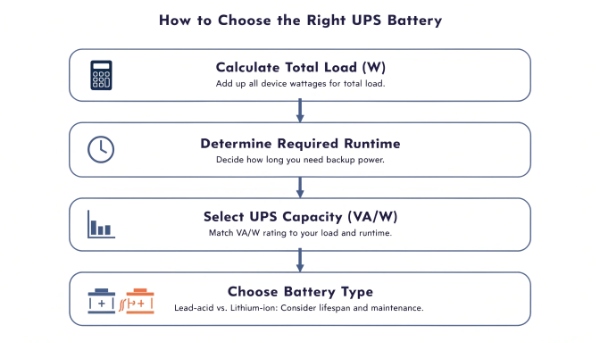
First, calculate your total load in watts. Then, decide on the required runtime in minutes. Use these two figures to select a UPS with the right capacity, and finally choose between lead-acid and lithium-ion.
A Step-by-Step Guide to a Perfect Match
As an OEM, we help clients spec out systems all the time. The process is straightforward if you follow a few logical steps. Getting this right is crucial for both performance and budget.
1. Calculate Your Total Load
First, make a list of every device you plan to connect to the UPS. Add up the total wattage of all these devices. You can usually find the wattage on the device's power adapter or back panel. Always add a 20-25% buffer for safety and future growth.
2. Decide on Your Runtime
How long do you need the power to stay on during an outage? Do you just need 5 minutes to safely shut down servers? Or do you need 30 minutes to an hour to wait for a generator to kick in? Be realistic about your needs.
3. Match the Load and Runtime to a UPS
Now you can select a UPS. The capacity of a UPS is given in Volt-Amps (VA) and Watts (W). Your total load wattage must be less than the UPS's wattage rating. As I always tell my clients, the type of load matters. A server with a large power supply requires a UPS with more capacity than a simple office PC with the same wattage, so choosing the right size is critical.
| Load | Required Runtime | Example UPS Capacity |
|---|---|---|
| 500W | 10 minutes | 1000VA / 700W |
| 1500W | 15 minutes | 3000VA / 2700W |
| 5000W | 30 minutes | 10kVA / 9000W |
How Can You Maximize UPS Battery Life?
You bought a battery with a 5-year lifespan, but it failed in two years. Replacing batteries so often is expensive and frustrating, and it defeats the purpose of your investment.
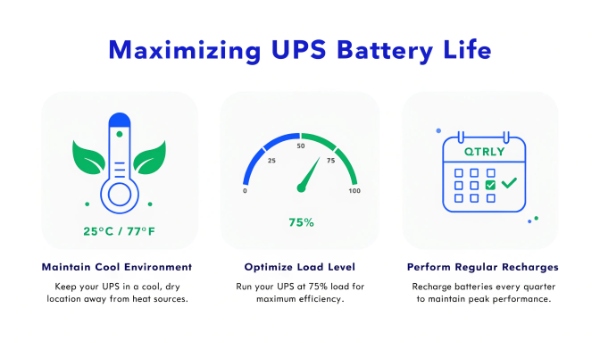
To maximize life, keep the UPS in a cool, dry place (around 25°C/77°F). Avoid running it at full capacity, and perform a full discharge/recharge cycle every few months. If storing the unit, recharge it quarterly.
Making Your Investment Last
A few simple best practices can easily double the effective life of your UPS battery. It's about creating the right conditions for the battery to perform as it was designed.
1. Control the Environment
Temperature is the single biggest factor in battery aging, especially for lead-acid. The "ideal" temperature is around 25°C (77°F). For every 8-10°C increase above this, the battery's expected life is cut in half. Keeping the UPS out of hot closets and in a climate-controlled room is essential.
2. Manage the Load
A UPS battery is like a car engine. It will last much longer if it isn't constantly running at its maximum limit. The sweet spot for longevity is to run your UPS at about 50-75% of its rated load. This reduces stress on the internal components and the battery itself.
3. Follow Storage Best Practices
This is a crucial insight for our wholesale partners and anyone storing units. Batteries self-discharge over time. If a UPS sits in a warehouse for a year without being charged, the battery can drain completely and suffer permanent damage. We always specify that to maximize a battery's shelf life, it must be recharged every three to four months to keep it healthy.
How Does the Supply Chain of UPS Systems and Components Work?
Sourcing a reliable UPS can feel like a black box. You worry about component quality, manufacturing standards, and delivery delays, which can derail your entire project timeline.
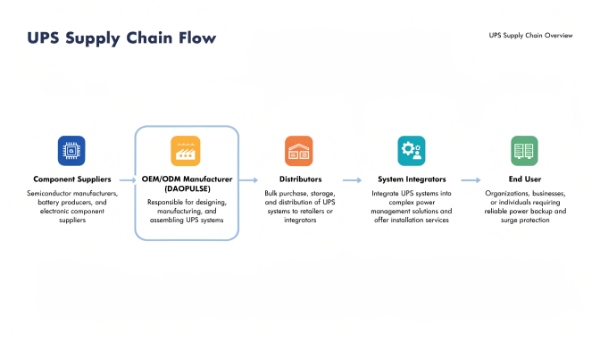
The chain starts with component sourcing (batteries, PCBs). An OEM/ODM manufacturer like us assembles and certifies the product. It's then shipped to distributors, integrators, or large clients for final installation.
From Raw Components to a Reliable Solution
Understanding the supply chain helps you, as a procurement manager, know where quality is built in and how to choose a reliable partner. Here is how it works from my perspective as an OEM/ODM manufacturer.
Tier 1: Sourcing Raw Components
It all begins with the individual parts. We maintain strong relationships with a network of trusted suppliers for critical components like battery cells, transformers, capacitors, and Printed Circuit Boards (PCBs). We select partners who meet our strict quality standards, as the final product is only as good as its weakest link.
Tier 2: The OEM/ODM Manufacturer (Our Role)
This is where the magic happens. We take these high-quality components and bring them into our ISO-certified factory. Our engineering team designs the UPS systems, sometimes customizing them for a specific client's needs. Our production lines assemble the units, and our quality assurance team conducts rigorous testing to ensure every UPS meets international standards like CE and RoHS. This is the most critical stage for ensuring reliability.
Tier 3: Distribution and Integration
Once a UPS is built, tested, and packaged, it enters the channel. We ship products to global brands who sell them under their own name, to wholesalers and retailers, or directly to system integrators who install them in projects like hospitals, data centers, and banks. Our role is to ensure this logistics process is seamless and efficient.
Conclusion
Understanding battery efficiency, replacement signs, and proper maintenance is key. Choosing a reliable OEM partner with a transparent supply chain ensures quality and performance, maximizing your investment in uninterruptible power.
-
Explore this resource to understand how load, temperature, and age impact UPS battery performance. ↩