
You have an old stabilizer and a new UPS. You're tempted to plug the UPS into it for 'extra' protection, but you're worried it might cause a problem or even a fire.
No, it is generally not recommended and is unnecessary. Most modern UPS systems, specifically Line-Interactive and Online models, already have a superior voltage stabilizer (AVR) built-in. Plugging them together can create conflicting adjustments, leading to inefficiency and potential damage to both devices.
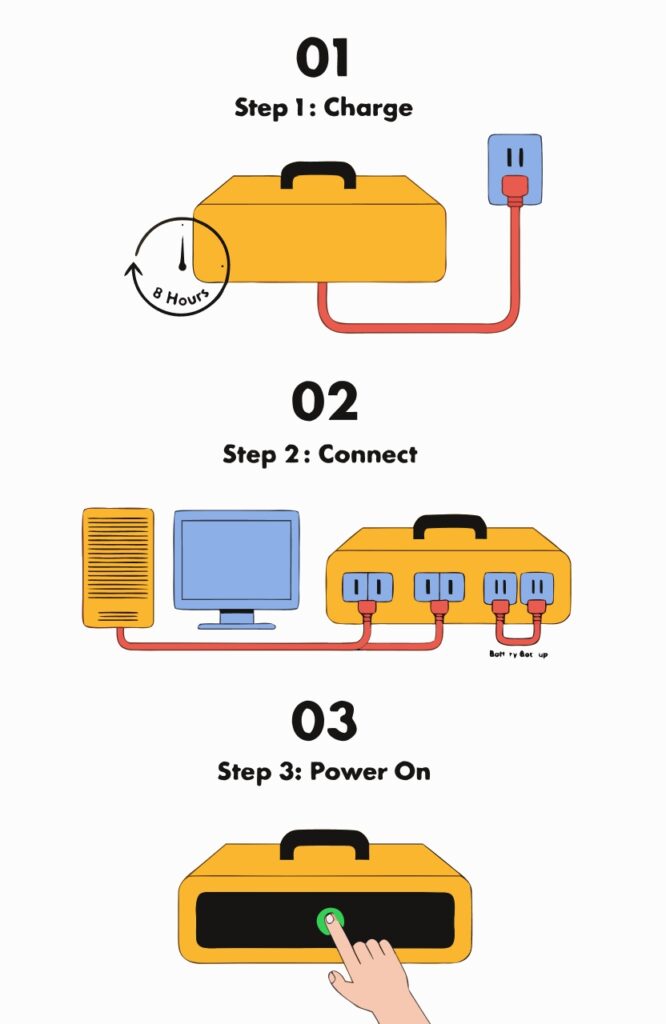
As someone who has been designing these systems for a decade, I get this question from well-meaning clients. They want to be extra careful, but they don't realize that a good UPS already does the stabilizer's job, but better. It's a case of redundant, and sometimes conflicting, systems. To understand why this is a bad idea, we first need to look at what each device is designed to do on its own. It's crucial to understand their individual roles before you even think about combining them.
What is a Stabilizer and a UPS used for?
Your power is unstable, and you know you need protection. You see stabilizers and UPS units for sale, but they seem to do the same thing, making the choice confusing and risky.
A stabilizer (AVR) is used for one job: correcting long-term voltage sags and swells. A UPS is used for total power protection: it stabilizes voltage, protects from surges, and provides instant battery backup power during a complete blackout.

One Job vs. All the Jobs
Think of it this way: a stabilizer, or Automatic Voltage Regulator (AVR), is like wearing glasses. It corrects your vision (the voltage) so you can see clearly, but that's all it does. A UPS is a full medical kit. It contains the glasses (the AVR function), but it also has bandages for cuts (surge protection) and a defibrillator for a heart attack (the battery backup for a blackout). A stabilizer is designed for environments with consistently poor but available power. It helps appliances like refrigerators and air conditioners survive in areas with chronic brownouts.
A UPS, on the other hand, is built for critical equipment where any interruption is unacceptable. This includes your computer, servers, or hospital equipment. Its main job is to ensure a continuous, clean supply of power, no matter what. It uses its built-in AVR for everyday fluctuations, but its most important feature is the battery that provides a seamless bridge of power during a total outage.
| Feature | Stabilizer (AVR) | UPS (Uninterruptible Power Supply) |
|---|---|---|
| Voltage Correction | Yes | Yes (Built-in) |
| Surge Protection | Limited / No | Yes |
| Blackout Protection | No | Yes |
| Primary Use | Appliances, non-critical loads | Computers, servers, critical loads |
How do a Voltage Stabilizer and a UPS Work?
You understand their purpose, but you're curious about what's happening inside the box. How do they actually fix the power? The mystery makes you unsure which technology is truly better for you.
A stabilizer uses a physical autotransformer with taps to 'boost' or 'buck' (lower) voltage. A Line-Interactive UPS uses a similar method for regulation but also has a battery. An Online UPS constantly regenerates a new, perfect power signal, offering total isolation.

The Mechanic vs. The Supercomputer
The way these devices work is fundamentally different in complexity.
The Mechanical Stabilizer
A standalone stabilizer works by using an autotransformer, which is a single coil of wire with multiple connection points, or "taps". When the stabilizer's simple circuit detects that the voltage is too low, a physical relay "clicks" and switches to a different tap on the coil to boost the voltage. If it's too high, it clicks to another tap to trim it down. This process is slow, mechanical, and creates a "stepped" output. It's a brute-force method.
The Intelligent UPS
A modern UPS is far more advanced. A Line-Interactive UPS has a similar AVR circuit, but it is controlled by a fast microprocessor. It makes adjustments much more smoothly and quickly. More importantly, its primary job is to monitor for a total failure. The moment power is cut, it switches to its battery and inverter in milliseconds, so your computer never notices. An Online UPS, the gold standard we build for data centers, works differently. It takes incoming AC power, converts it to DC, and uses that DC to regenerate a brand new, perfectly clean AC signal. Your equipment is never connected to the raw grid, providing total isolation.
What are the differences between UPS, IPS and AVR?
You see all these acronyms: UPS, IPS, AVR. It's a confusing alphabet soup, and you're worried about buying the wrong device because you don't understand the critical differences in the terminology.
AVR (Automatic Voltage Regulator) only stabilizes voltage. A UPS (Uninterruptible Power Supply) provides instant battery backup (<10ms). An IPS (Inverter Power System) is a slower-switching system designed for longer runtimes for lights and fans, not sensitive electronics.
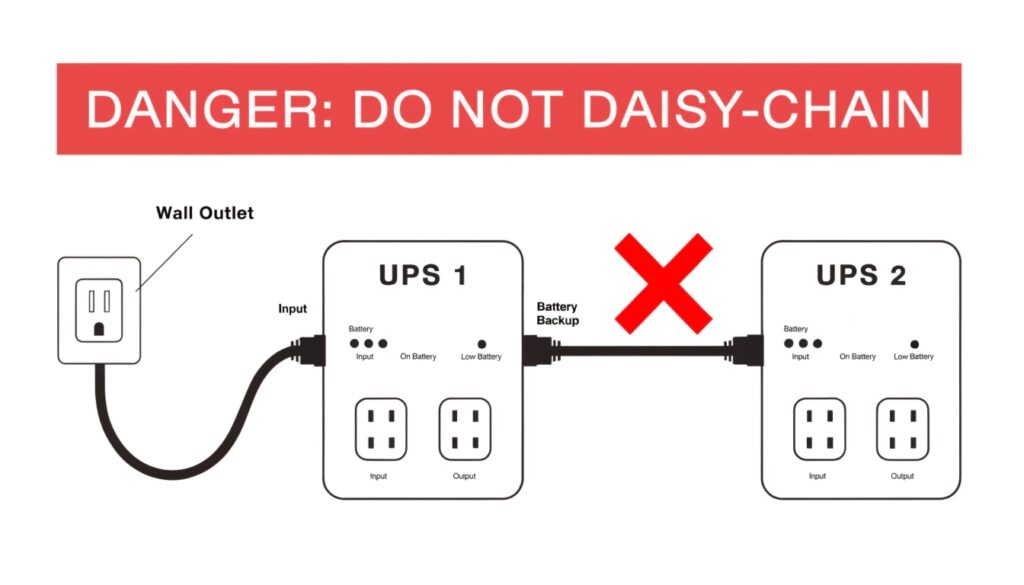
It's All About Time
As a manufacturer, this is a distinction we must get right. The single most important difference between these devices for protecting a PC is the transfer time. This is how long it takes the device to switch to battery power after a blackout.
| Feature | AVR (Stabilizer) | UPS | IPS (Inverter Power System) |
|---|---|---|---|
| Primary Function | Voltage Regulation | Uninterruptible Backup | Long-Term Backup |
| Transfer Time | N/A (No Battery) | <10 milliseconds | >50 milliseconds (Often much longer) |
| Output Waveform | Same as input | Pure or Simulated Sine | Often Square Wave |
| Best Use Case | Appliances | Computers, Servers | Lights, Fans, Motors |
Your computer's power supply has capacitors that can keep it running for about 15-20 milliseconds without power. A UPS is designed to switch over in less than 10 milliseconds, well within this safety window. Your PC never loses power. An IPS, often a regional term for a simpler inverter system, might take 50, 100, or even 500 milliseconds to switch. By then, your PC has already crashed. An AVR has no battery, so its transfer time is infinite—it just turns off.
Does an AVR really protect a PC from a power outage?
You see an AVR is much cheaper than a UPS. You're tempted to save money by just getting the stabilizer, but you're afraid it won't be enough protection when a full blackout actually hits.
No, absolutely not. An AVR (Automatic Voltage Regulator) can only correct low or high voltage while power is still on. During a complete power outage or blackout, an AVR is completely useless and provides zero protection. Your PC will shut off instantly.
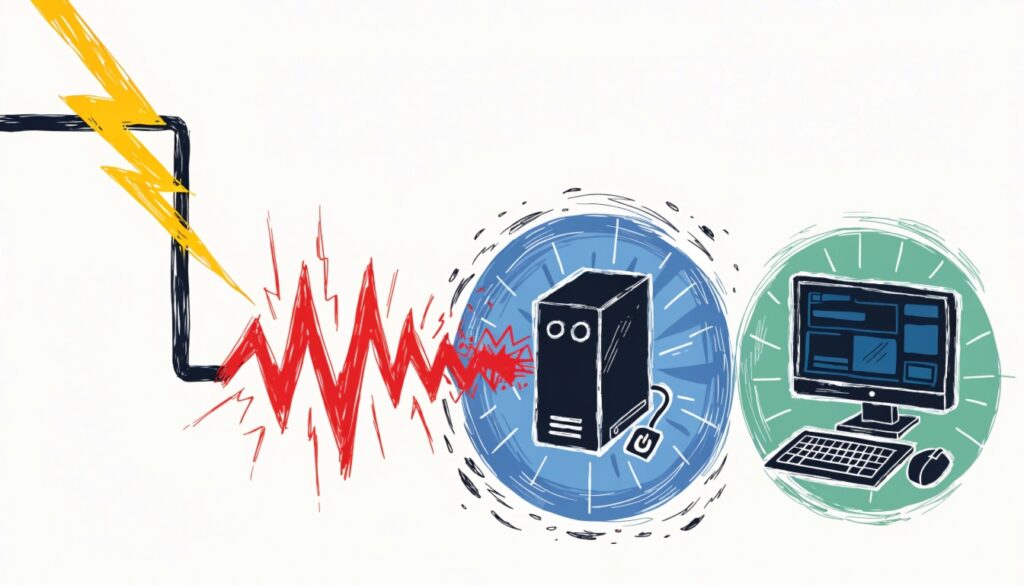
A Regulator Cannot Create Power
This is the most critical point to understand. An AVR is a power conditioner, not a power source. It can only take the electricity it is given and adjust its voltage. It has no internal battery. It has no inverter to create its own AC power. When the input power drops to zero volts during a blackout, the AVR has nothing to regulate. Its output also immediately drops to zero volts. There is no backup.
Relying on an AVR for outage protection is like expecting your car's cruise control to keep you moving after your engine has died. The cruise control can only regulate the engine's speed; it can't become the engine. In the same way, an AVR can only regulate the grid's voltage; it cannot become a power source when the grid fails. For a power outage, the battery inside a UPS is the only thing that can protect your PC from an immediate, data-corrupting shutdown.
Conclusion
Plugging a UPS into a stabilizer is redundant and risky. A modern UPS includes superior voltage regulation, making a separate stabilizer unnecessary while providing complete protection against all power problems.