
Your power flickers, causing annoying reboots. You know you need something, but you're torn between a cheaper AVR and a more expensive UPS. Making the wrong choice feels risky.
A UPS is the best choice. An AVR (Automatic Voltage Regulator) only stabilizes voltage. A modern UPS includes AVR functionality to stabilize voltage and provides battery backup to protect against complete blackouts, offering a total power solution.
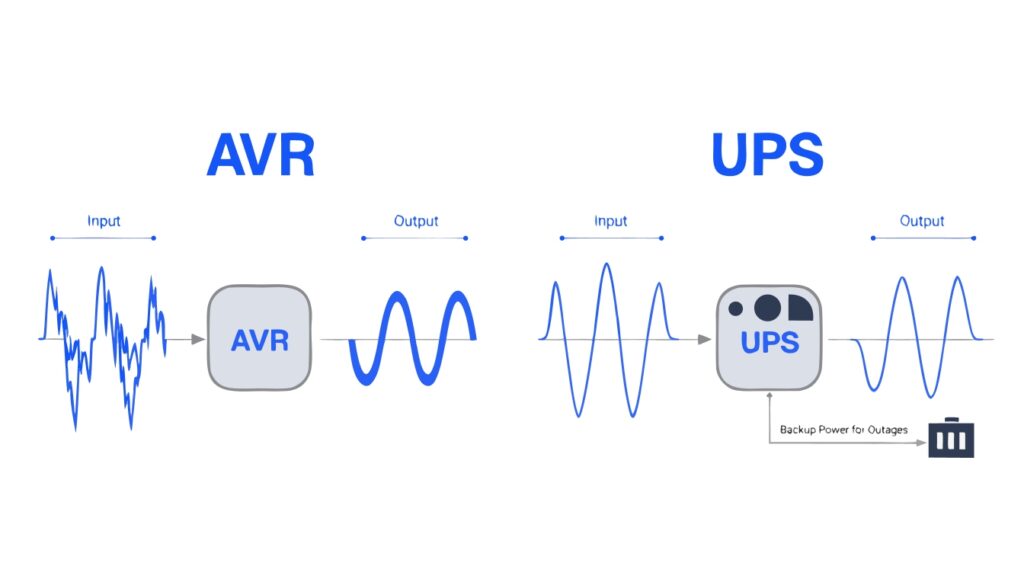
In my 10 years of designing power protection systems, this is one of the most common questions I get from procurement managers. They want to protect valuable equipment, but they also need to be cost-effective. It's tempting to see the AVR as a "good enough" solution. However, an AVR only solves one piece of the power puzzle. A UPS is designed from the ground up to be a complete guardian for your electronics, handling everything from tiny voltage dips to a total grid failure. Let's break down exactly what each device does.
What are the Differences between a UPS and a Regulator?
You see two boxes that promise clean power, but one costs half as much. You wonder if the cheaper regulator is a smart saving or just a waste of money that leaves you vulnerable.
A regulator (AVR) is a one-trick pony: it adjusts unstable voltage. A UPS is a complete protection system that regulates voltage, protects from surges, and provides emergency power from a battery when the utility fails completely.
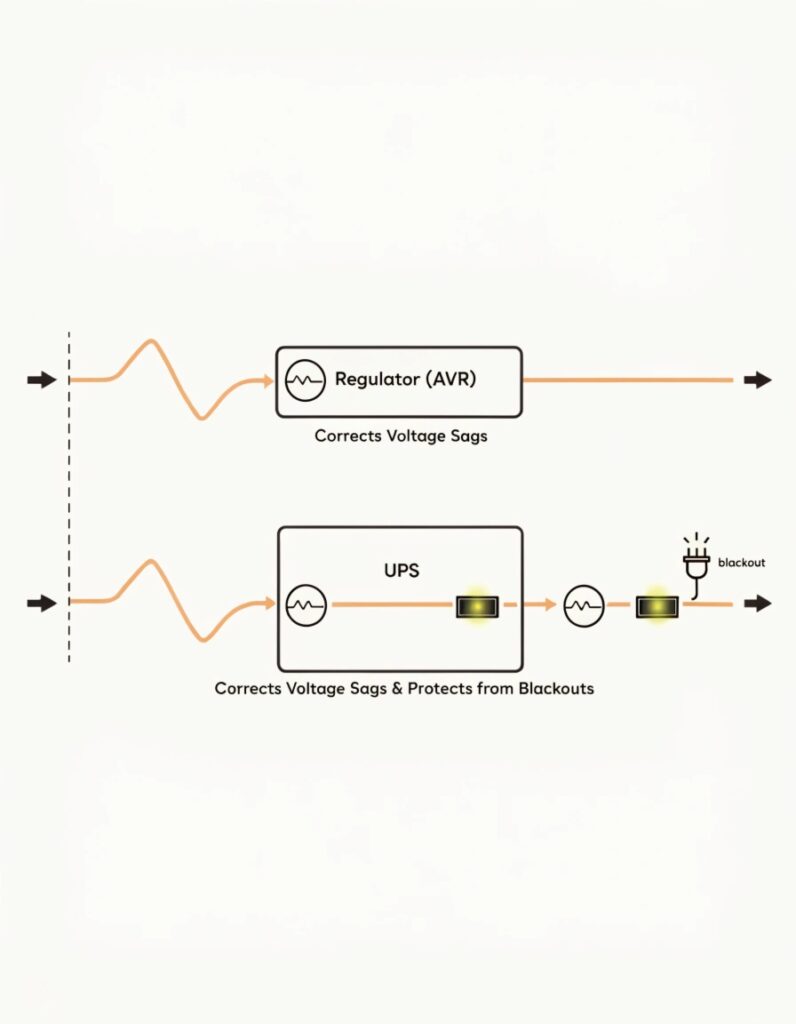
One Job vs. All the Jobs
The core of my insight is this: a UPS and a regulator have different roles, but the UPS can also provide backup power support. Think of it like this: an AVR is like cruise control in your car. It keeps your speed steady on the highway, adjusting for small hills. It’s useful, but that's all it does. A UPS is the entire car's safety system. It has cruise control (voltage regulation), but it also has airbags and a seatbelt (surge protection) and a spare tank of gas (the battery).
An AVR physically adjusts its internal transformer to "boost" low voltage or "buck" high voltage. That's its only function. A Line-Interactive or Online UPS has this capability built-in, but it's part of a much larger, more intelligent system. The UPS's main brain is focused on the battery and being ready for a total outage, which is the most dangerous event for your data and hardware. An AVR is completely useless in a blackout.
| Feature | AVR (Regulator) Only | UPS (Line-Interactive/Online) |
|---|---|---|
| Corrects Low/High Voltage | Yes | Yes |
| Protects from Surges | Limited / No | Yes |
| Provides Power in a Blackout | No | Yes |
| Complete Protection | No | Yes |
Does a good UPS regulate voltage?
You bought a UPS to protect you from blackouts. But you still see lights flicker and wonder if the UPS is actually doing anything to fix those smaller, everyday power problems.
Yes, absolutely. Most quality UPS systems, specifically Line-Interactive and Online models, have a built-in Automatic Voltage Regulator (AVR). This feature is constantly working to smooth out power fluctuations without using the battery, protecting your hardware from long-term damage.
The Unseen Guardian
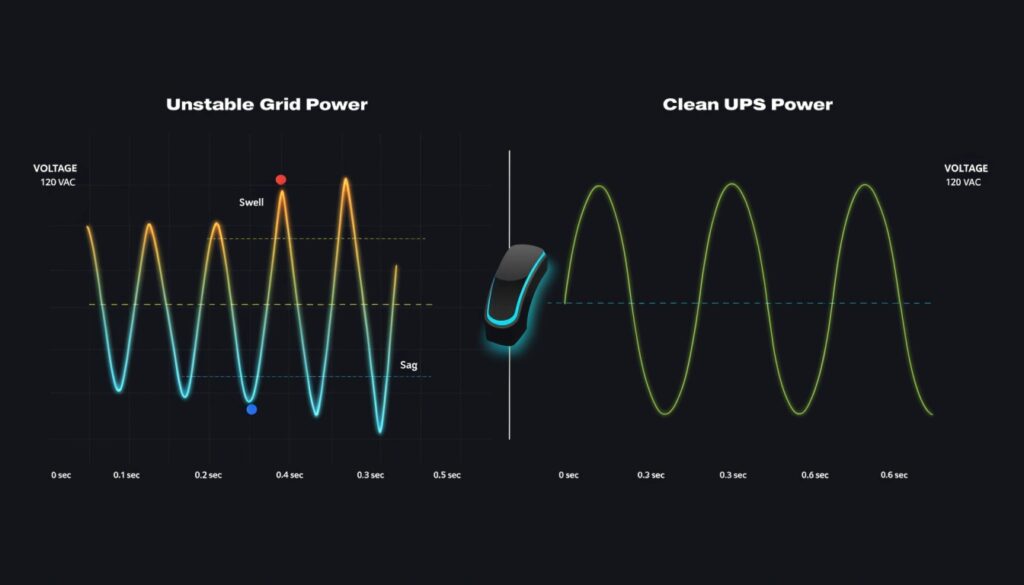
Many people think a UPS just sits there waiting for a blackout. But a good Line-Interactive or Online UPS is working for you 24/7. Your utility power is rarely a perfect, stable voltage. It's constantly fluctuating, with sags (brownouts) and swells (over-voltage conditions). These small variations won't shut your computer off, but they cause immense stress on its internal power supply. This stress generates heat and leads to premature component failure.
This is where the UPS's built-in AVR shines. It constantly monitors the incoming voltage. When it dips below a safe level, the AVR boosts it. When it climbs too high, the AVR trims it back. It does all of this instantly and without switching to the battery. This means the battery is saved for a real emergency (a blackout), and your equipment gets a steady diet of clean, regulated power all day long. As manufacturers, we consider this a non-negotiable feature for any serious power protection device. It’s a key part of what separates a true UPS from a simple battery box.
Does a UPS protect a computer from high voltage?
A thunderstorm is rolling in, and you worry about a lightning strike. You wonder if that UPS box is really enough to stop a massive voltage spike from frying your expensive computer.
Yes. A UPS is your best defense against high voltage. It provides robust surge protection to clamp down on dangerous spikes. An Online UPS offers the ultimate protection by completely isolating your computer from the utility power grid.
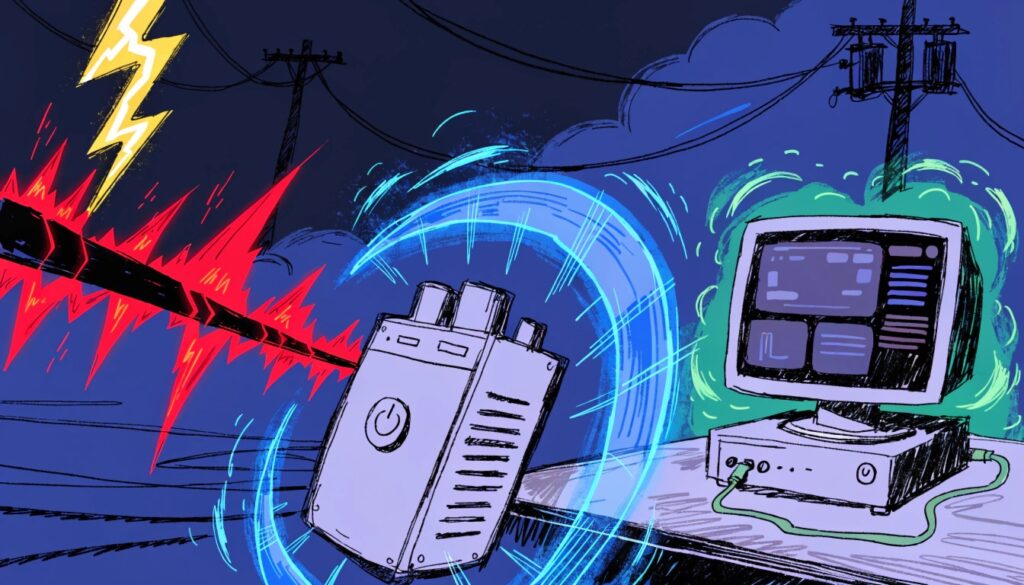
A Multi-Layered Shield
Protecting against high voltage is a core design principle for any UPS we build. We approach it in two primary ways. First, every UPS we make has a robust surge suppression circuit built right in. This circuit uses components called Metal Oxide Varistors (MOVs) that act like pressure release valves for electricity. When they detect a sudden, dangerous voltage spike, they instantly divert that excess energy safely to the ground wire, preventing it from ever reaching your computer. This is your first line of defense.
The second, more absolute form of protection comes from our Online Double-Conversion UPS models. This technology is like an electrical fortress. It takes incoming AC power, converts it to DC, and then uses that DC to regenerate a brand new, perfectly clean AC signal for your computer. Your computer is never directly connected to the outside power line. A massive surge on the input can't get through because the power is completely rebuilt. For hospitals, data centers, and anyone with truly irreplaceable equipment, this total isolation is the only acceptable level of protection.
Does a UPS stabilize voltage for a PC?
Your PC acts weird sometimes, with random crashes or glitches. You suspect it might be your power, and you need to know if a UPS is the right tool to fix it.
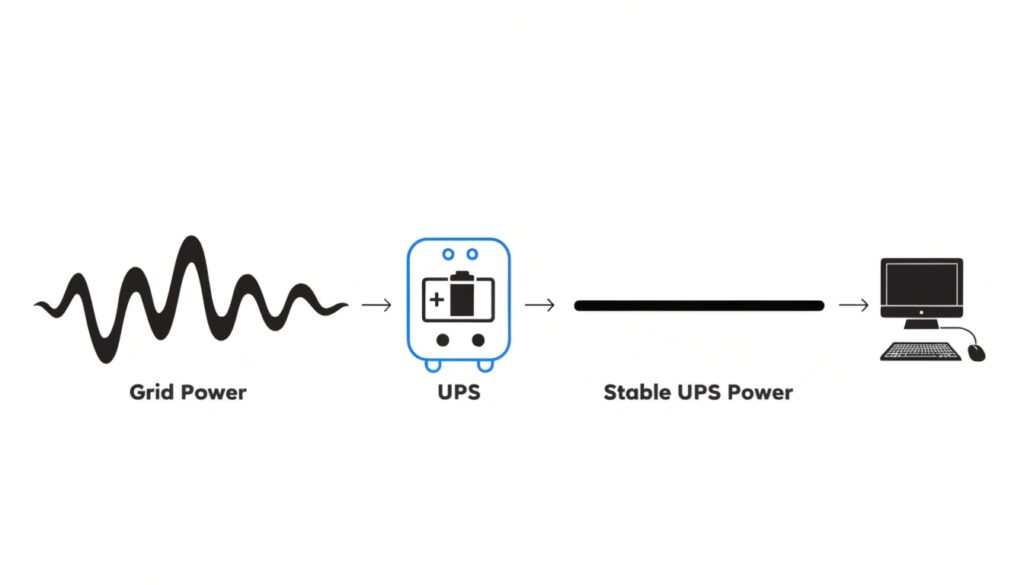
Yes, that is one of its primary functions. A UPS with AVR technology is the best way to deliver stable voltage to a PC. It smooths out the constant sags and swells from the grid, which prevents system instability and component stress.
The Foundation of Performance
A PC's internal power supply is designed to take the AC from your wall and convert it into various stable DC voltages for the internal components. However, it can only do its job well if the incoming AC power is reasonably stable. When the voltage from your wall is constantly dipping and spiking, the PC's power supply has to work much harder. This extra work creates heat, reduces efficiency, and can lead to calculation errors or system freezes. Over time, this stress will cause the power supply to fail.
An AVR-only device can help with this, but it's an incomplete fix. It can't do anything about a momentary outage or a sharp electrical spike. A Line-Interactive UPS provides a complete solution. It stabilizes the voltage day-to-day, protecting the PC's power supply from chronic stress. It clamps down on dangerous surges. And most importantly, it provides that seamless bridge to battery power, so even a split-second outage doesn't cause a system crash and data loss. For PC stability, a UPS provides the stable foundation everything else relies on.
Conclusion
An AVR is a limited tool for voltage correction. A UPS is a comprehensive power solution. It stabilizes voltage, protects from surges, and provides critical backup power, making it the superior choice for protecting any valuable electronics.