
You see a UPS as a simple black box, but you have no idea what's inside. This makes it hard to choose the right one or understand what's wrong when it beeps.
The major components are the rectifier, batteries, inverter, and static bypass switch. The rectifier converts AC to DC to charge the batteries, the batteries provide power during outages, and the inverter changes the DC power back to usable AC for your devices.
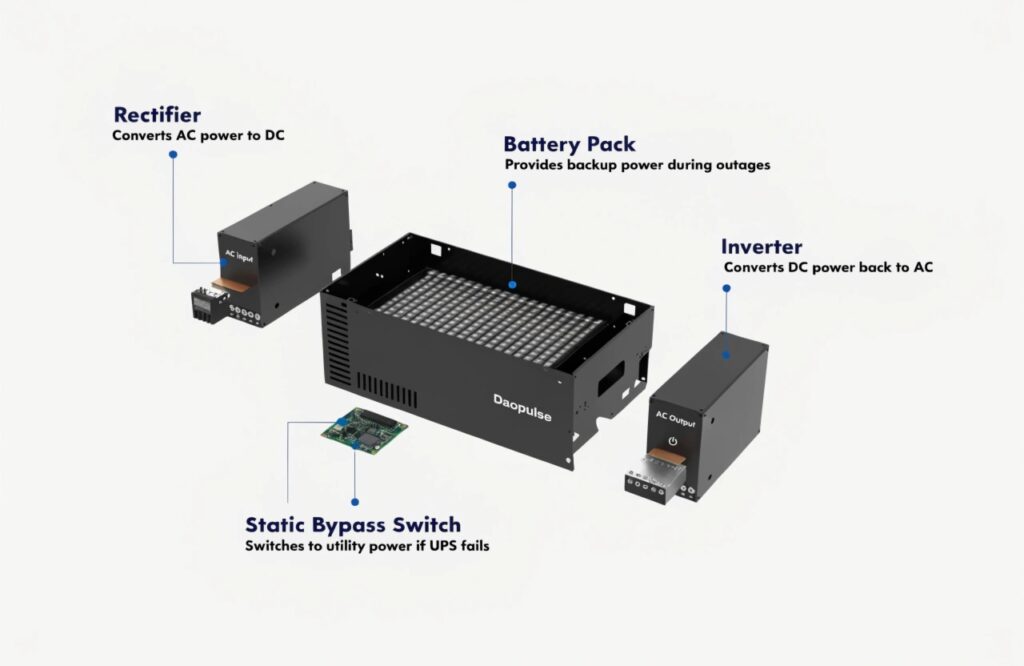
For over a decade, I've been designing these systems for critical applications. It's easy to take them for granted, but inside every one of our UPS units is a carefully engineered team of components working in perfect harmony. They don't just provide power; they guard your equipment against the chaotic and unpredictable nature of the grid. Understanding these parts is the first step to appreciating the total peace of mind a quality UPS provides. Let's take a look at how they work together.
How do UPS systems work and what are their benefits?
You know you need a UPS for power outages, but you are not sure how it really works. This uncertainty makes it hard to see its full value beyond just acting as a battery.
A UPS works by constantly monitoring utility power. An online UPS continuously regenerates a new, clean AC signal from its battery power. Its key benefits are 100% uptime, protection from all power problems, and extended hardware life.
The Path of Perfect Power
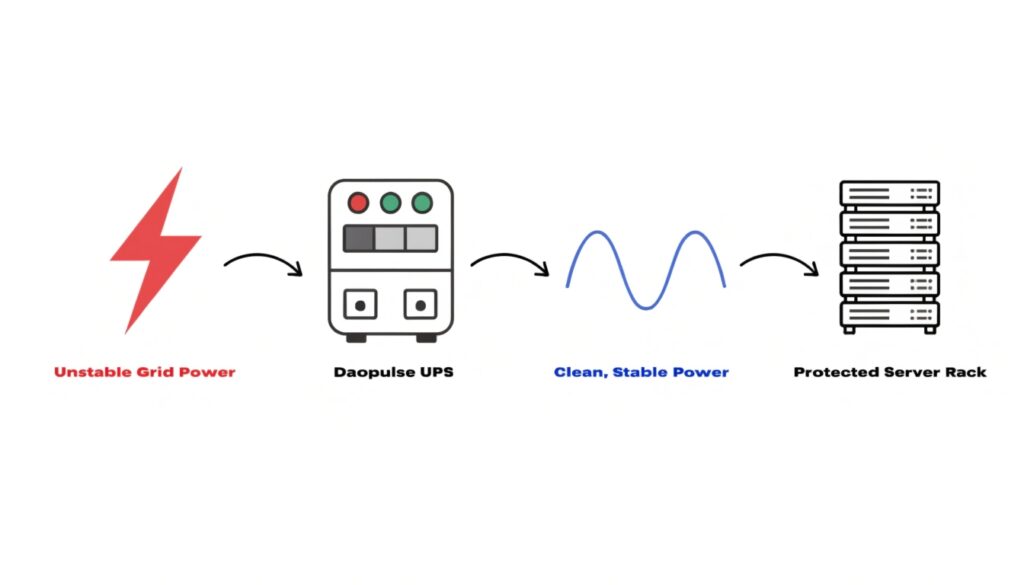
The best way to understand how a UPS works is to follow the path of electricity through one of our online double-conversion models. This is the technology we use in all our mission-critical systems. First, messy AC power from the wall enters the UPS and goes straight to the rectifier. The rectifier's job is to convert this AC power into clean DC power. This DC power does two things at once: it charges the batteries and it powers the inverter. The inverter's only job is to take that clean DC power and create a brand new, perfect AC sine wave. This perfect power is what feeds your sensitive equipment.
Your equipment is never directly connected to the unstable power grid. It is always running off the perfect power created by the inverter. When a blackout happens, the rectifier just shuts off. The batteries are already connected, so they seamlessly continue to power the inverter with zero interruption. There is no switchover time. Your equipment never even knows the grid is gone.
| Benefit | How It's Achieved | Why It Matters for You |
|---|---|---|
| 100% Uptime | Online design means zero transfer time to battery. | No data loss or system reboots during outages. |
| Total Protection | Power is completely rebuilt, filtering all noise, sags, and surges. | Prevents hardware damage and extends equipment lifespan. |
| Power Consistency | Output voltage and frequency are perfectly regulated. | Sensitive equipment operates reliably without errors. |
How can I add a backup battery to a power supply?
You have an important device with its own power supply and want to add battery backup. You think you might be able to just wire a battery into the system somehow.
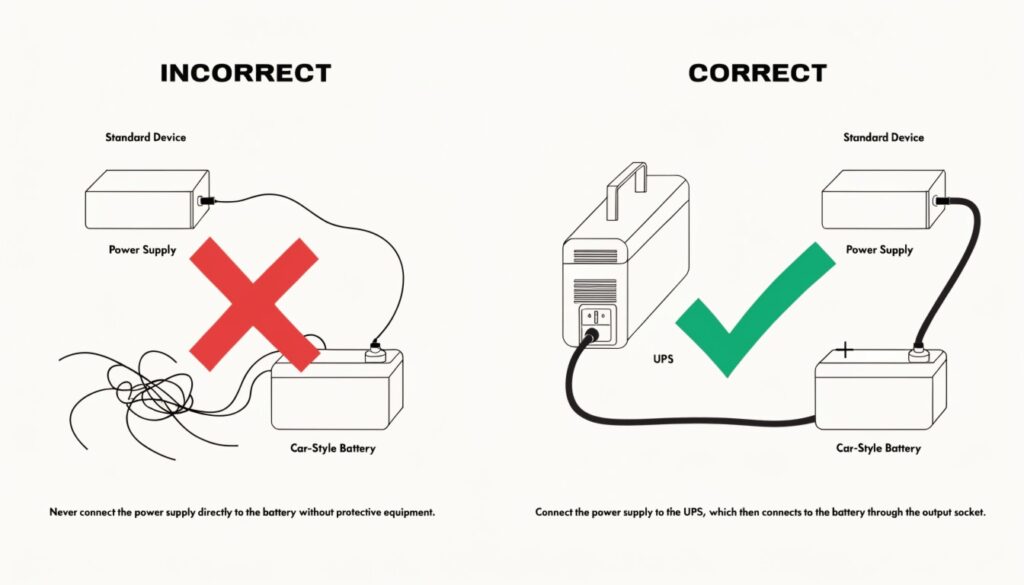
You cannot safely add a battery directly to a standard power supply. Instead, you must plug the power supply's cord into the outlet of a complete UPS unit. The UPS provides the integrated battery, charger, and inverter system needed.
The All-in-One Solution
I get asked this sometimes by engineers working on custom projects. It's a tempting idea, but it's dangerous and will not work. A standard power supply is designed to take a specific AC voltage input, like the one from your wall. It has no circuitry to charge a battery, manage its voltage, or convert the battery's DC power back into AC. Attempting to connect a battery directly will likely damage the power supply, the battery, or both, and is a significant fire risk.
The right solution is a UPS because it is designed specifically for this task. It is a complete, self-contained system. Think of what you're really asking for: a device that can charge a battery, switch to it instantly, and convert its power. That is the exact definition of a UPS. It has all the necessary parts integrated and tested to work together safely. As a manufacturer, we ensure these components are perfectly matched for safety and reliability. You don't just need a battery; you need the entire support system around it.
| Feature Required | DIY with Battery | Complete UPS Solution |
|---|---|---|
| Battery Charging Circuit | No | Yes (Rectifier) |
| DC to AC Conversion | No | Yes (Inverter) |
| Automatic Switching | No | Yes (Static Switch) |
| Safety Certifications | No | Yes (CE, RoHS) |
Is a UPS the same as a generator?
Both a UPS and a generator give you power when the grid fails. This leads many people to think they are interchangeable, which can lead to expensive equipment damage.
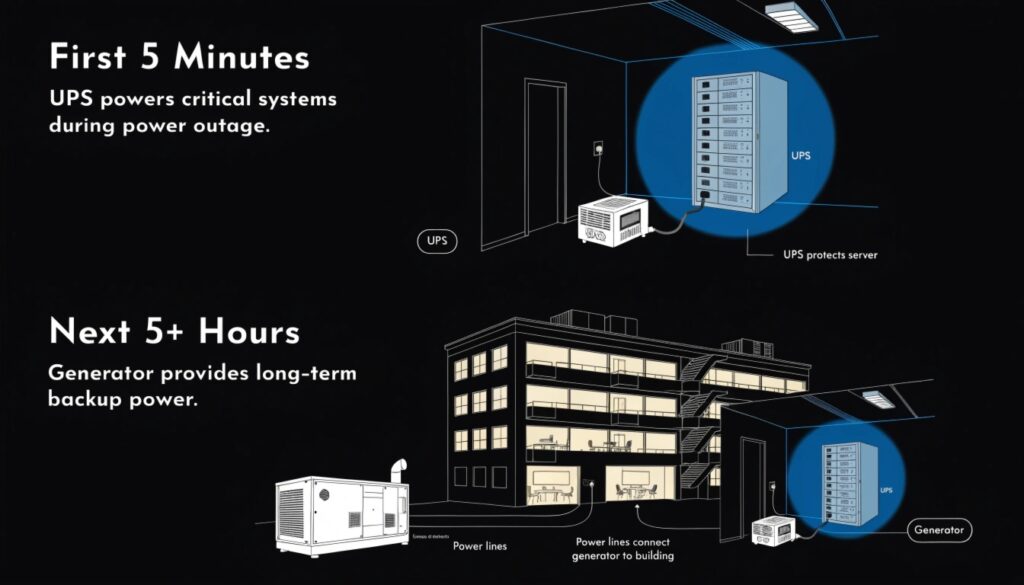
No, they are very different. A UPS provides instant, clean power for minutes. A generator provides long-term, dirty power after a delay. A UPS protects equipment; a generator provides endurance. They serve two different but complementary roles.
Different Tools for Different Jobs
A generator is just an engine that spins a coil to make electricity. As I often explain to partners, a UPS has many more functions than a generator's engine. A UPS is a power quality device first and a backup device second. Its online double-conversion process means it is constantly conditioning and purifying power. A generator, on the other hand, creates very unstable or "dirty" power. The voltage and frequency can fluctuate, which is very dangerous for sensitive electronics.
A UPS provides instantaneous power, with zero switchover time. A generator needs time to start up, often 30 seconds or more. In that gap, all your systems would crash. The ideal solution for total reliability, which we build for hospitals and data centers, is to use them together. The UPS takes the initial load instantly, keeping everything running. When the generator starts, the UPS then conditions the generator's dirty power, protecting the equipment while drawing from the generator to run the load and recharge its own batteries.
| Feature | UPS (Online) | Generator |
|---|---|---|
| Power Quality | Perfect, clean sine wave | Unstable, "dirty" power |
| Switchover Time | Instantaneous (0 ms) | Seconds to minutes |
| Primary Function | Power perfection and short-term bridge | Long-term power generation |
| Best Use | Protect sensitive electronics | Power an entire building for hours/days |
What is an inverter and a UPS?
You hear the technical terms "inverter" and "UPS" and they seem to be used interchangeably. This makes it confusing when you are trying to find the right power solution.
An inverter is a single component that changes DC power into AC power. A UPS is a complete system that includes an inverter, plus a battery, a charger, and the control logic to manage them all and protect your equipment.
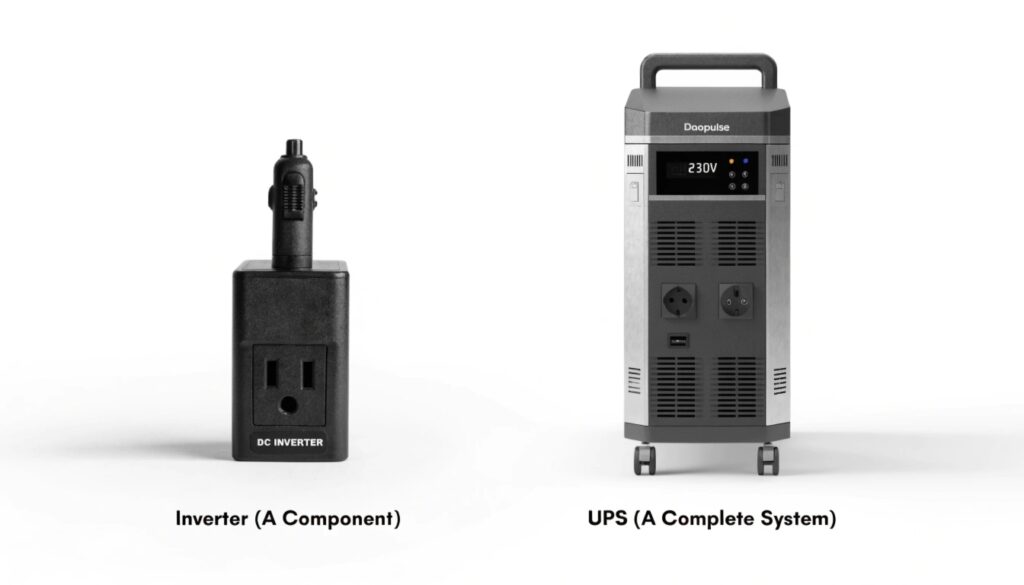
A Part Versus the Whole Machine
Let me use an analogy I often use with new procurement managers. An inverter is like the engine of a car. Its one job is to convert one form of energy to another (DC to AC). You can buy an engine by itself. But an engine alone can't get you to work.
A UPS is the entire car. It has the engine (the inverter), but it also has the fuel tank (the battery), a way to fill the tank (the rectifier/charger), a transmission (the static switch), and a driver at the wheel (the control system). All these parts are engineered to work together to provide a smooth, reliable ride for your electrical load. You can't just have an inverter for backup; what would charge the battery? What would switch to it when the power fails? The UPS integrates all these functions into one tested, reliable box. So, while a UPS contains an inverter, the UPS itself is a much more comprehensive and intelligent solution.
Conclusion
The core components of a UPS—rectifier, battery, and inverter—are engineered to work as a complete system. They deliver much more than backup power; they provide total power reliability for your critical equipment.