
You live in an area with unstable electricity. Your lights flicker, and you worry that these power fluctuations are slowly killing your expensive electronics. You know a stabilizer can help, but you've also heard a UPS is better.
Yes, most UPS systems work as excellent stabilizers. Line-Interactive and Online UPS models have a built-in Automatic Voltage Regulator (AVR). This feature corrects high and low voltage automatically, providing clean, stable power without even using the battery.
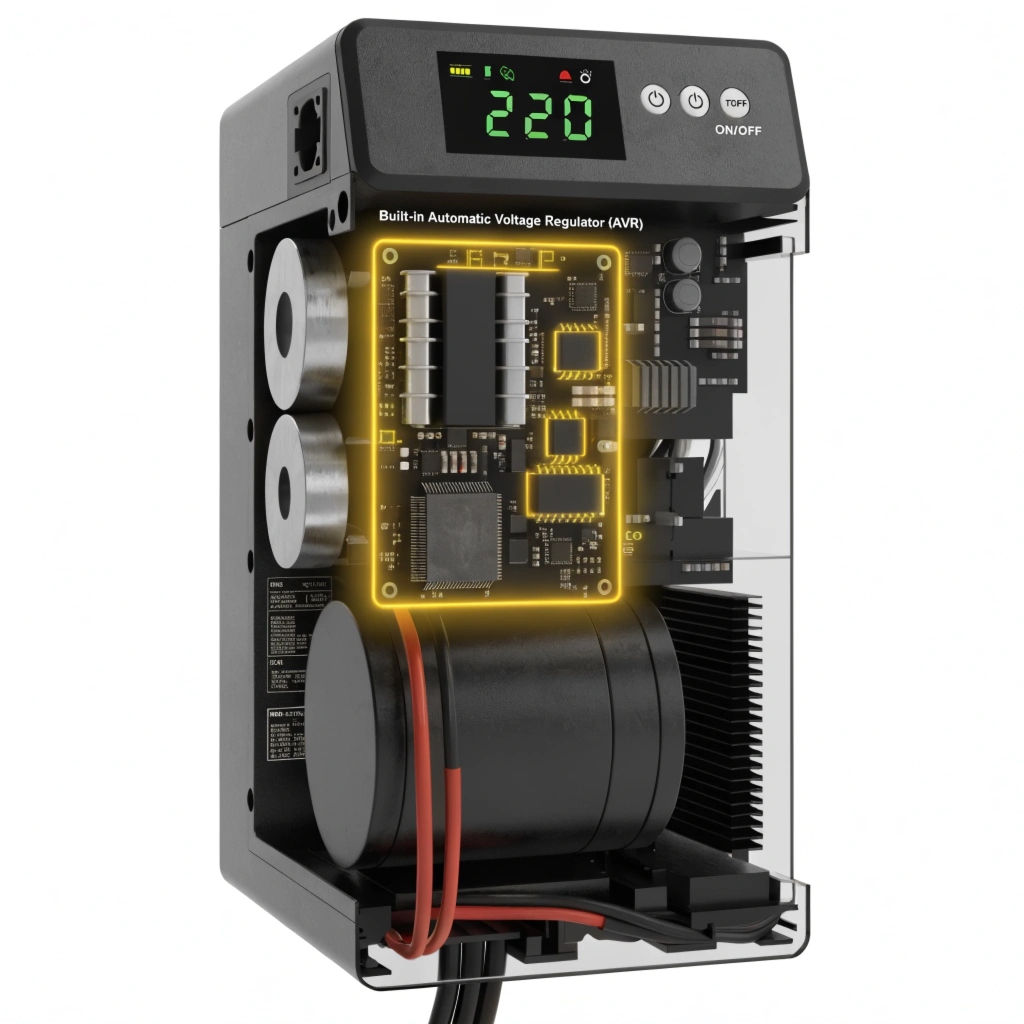
The core insight I've learned from 10 years of manufacturing power solutions is that a stabilizer and a UPS are fundamentally different, even though a UPS contains a stabilizer's function. A stabilizer's only job is to regulate voltage. A UPS does that and so much more. Understanding this difference is key to seeing the true value of a UPS and why, for some functions, it's absolutely irreplaceable.
Is It Worth It to Run a UPS with No Battery?
Your UPS is beeping to warn you of a dead battery. A replacement is on its way, but for now, you wonder if you can just keep using it. You hope it's still offering some protection from surges.
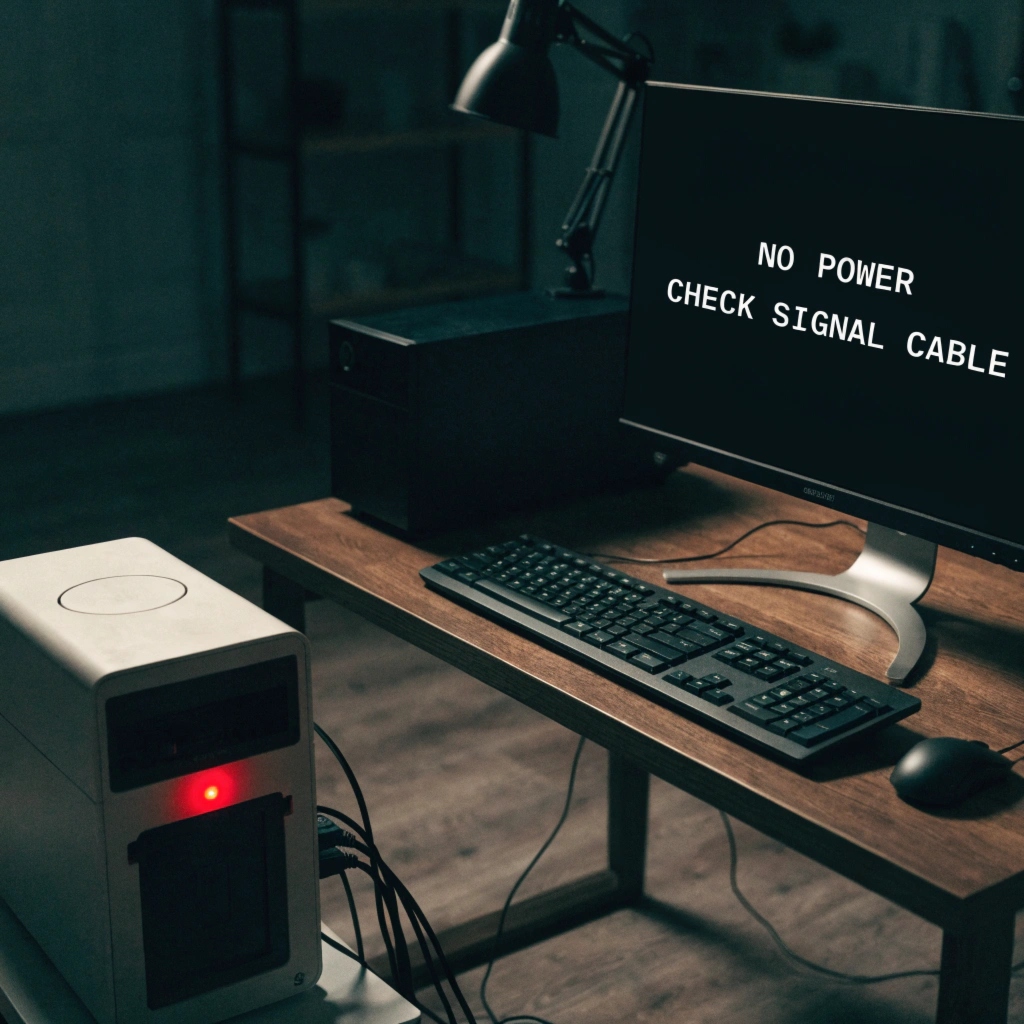
No, running a UPS without a working battery is a bad idea. It loses its primary function—backup power—and its other protective features like voltage regulation may become unreliable. It effectively becomes a very expensive and inefficient surge protector.
An Empty Shell
I get this question from clients sometimes. They hope to squeeze a little more life out of the unit. But a UPS is a complete system, and the battery is its heart. Without it, the system fails. On a basic Line-Interactive UPS, the surge protection circuits might still work because they are often separate. However, the Automatic Voltage Regulator (AVR) may not. The UPS's control board constantly checks for a healthy battery. If it detects a fault, it might disable the AVR or go into a bypass mode, passing raw, unstable grid power directly to your computer. You think you're getting stabilized power, but you're not. For an Online UPS, it's even worse. The double-conversion design absolutely requires the DC power bus, which is anchored by the battery. Without a battery, an Online UPS will likely not even turn on. You lose all protection. It's not a risk worth taking.
What is the Purpose of a UPS in a Computer?
You just invested over a thousand dollars in a new PC. The thought of a random power outage corrupting your operating system or destroying your unsaved work is a constant worry. How can you secure your investment?
The main purpose is to provide continuous, clean power. It gives you time to save your work and shut down properly during a blackout. It also actively protects your PC from daily power surges and voltage swings that can degrade components over time.

More Than Just Backup
The most obvious purpose of a UPS is to prevent the chaos of a sudden shutdown. Losing an unsaved document is frustrating, but the damage can be much worse. A blackout during a Windows update can corrupt the entire operating system, forcing you to reinstall everything. It can also cause errors in your hard drive's file system. The UPS provides a bridge of power, a calm window of time to save everything and shut down gracefully.
But the protection goes deeper. Your computer's internal power supply (SMPS) is constantly stressed by minor voltage sags and swells from the grid. This daily wear and tear shortens its lifespan. A UPS with an AVR absorbs these fluctuations, feeding your computer a perfectly stable voltage. In my experience as a manufacturer, I see a UPS not just as an emergency device, but as a full-time power conditioner that extends the life of the electronics plugged into it. It's guarding your hardware 24/7.
| Power Problem | Risk to PC | How a UPS Solves It |
|---|---|---|
| Blackout | Data loss, OS corruption | Provides battery power for safe shutdown |
| Surge | Fried motherboard or PSU | Absorbs and blocks high voltage spikes |
| Brownout | System crash, component stress | Boosts voltage to a stable level |
| Noise | Data errors, glitches | Filters out electrical interference |
What is a UPS System?
You see the term "UPS" and think of it as a single item, like a battery. This can be confusing when you see different types and prices. You're not sure what you're actually buying.
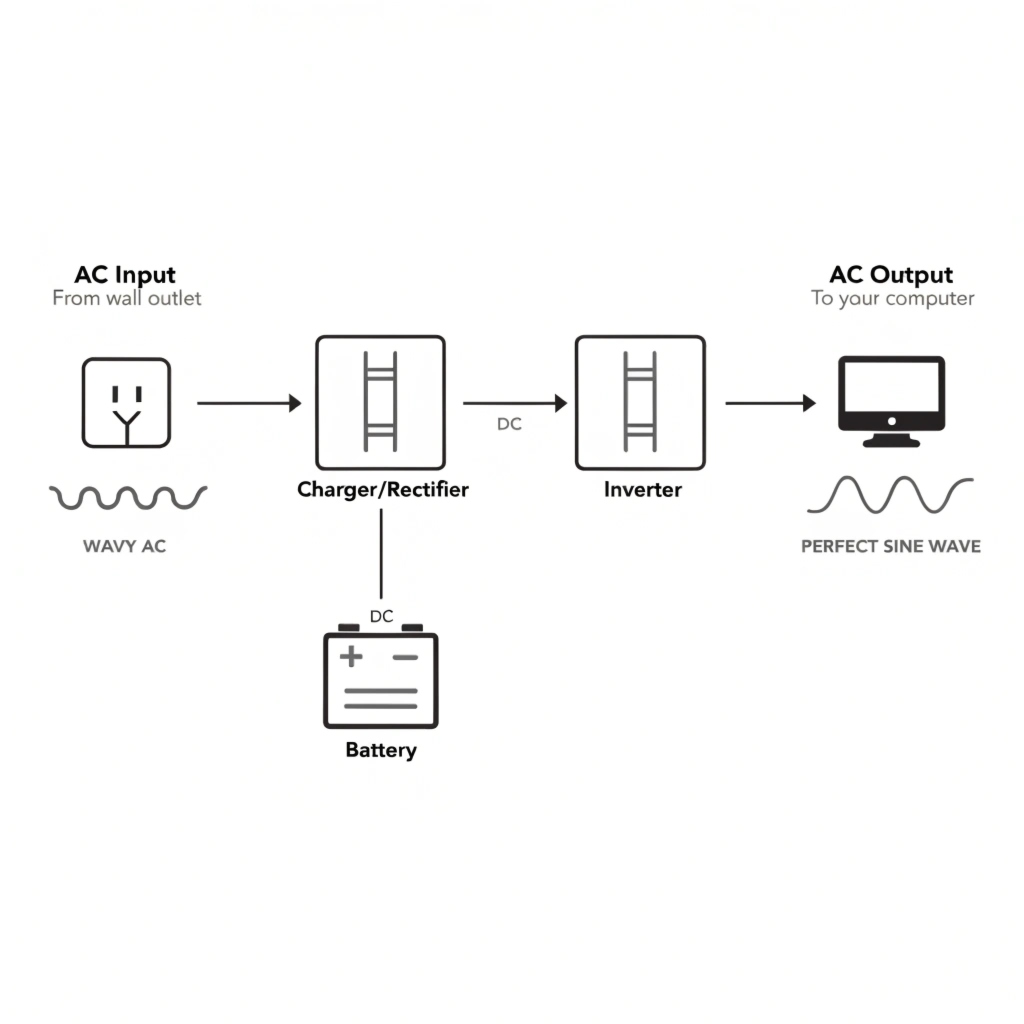
A UPS is a complete system of components that work together. It includes a battery for energy storage, an inverter to create AC power, and control circuits to manage power flow and protect against electrical problems.
A System of Protections
Thinking of a UPS as a "system" is the right way to understand it. It's not just a box with a battery inside. When we design a UPS, we are engineering several key modules to work in perfect harmony.
- The Battery: This is the energy reservoir. We work with both traditional lead-acid for cost-effective solutions and modern lithium-ion for longer life and higher efficiency, depending on our client's needs.
- The Charger (or Rectifier): This component takes the incoming AC power from the wall and converts it to DC power to keep the battery charged.
- The Inverter: This is the real magic. The inverter takes the DC power from the battery and converts it back into clean AC power for your computer to use during an outage. The quality of this inverter is critical for sensitive electronics.
- The Transfer Switch and AVR: In Line-Interactive models, this is the brain that detects a power problem and instantly switches to battery or engages the Automatic Voltage Regulator (AVR) to correct the voltage. It’s what makes a UPS faster and better than a simple stabilizer.
It’s the integration of all these parts that makes a UPS so effective.
Which is Better, a UPS or a Stabilizer for a TV?
Your big-screen TV is the centerpiece of your living room, but the power in your area is unstable. You want to protect it, but a UPS seems like overkill. You are stuck between choosing a stabilizer or a UPS.
For a TV, a voltage stabilizer is usually the better and more cost-effective choice. TVs are vulnerable to voltage damage but don't risk data loss from a sudden shutdown, making the battery backup feature of a UPS unnecessary.

The Right Tool for the Job
As an OEM/ODM partner, we always advise our clients to match the solution to the problem. A TV's biggest enemy is not a blackout, but the constant stress of unstable voltage. Brownouts and surges can wear out the TV's internal power supply board over time, leading to expensive repairs. A good voltage stabilizer is designed specifically to solve this one problem. It ensures the TV gets a steady, clean voltage, protecting it from this long-term damage.
A UPS does this too, but it also includes a battery and inverter, which adds significant cost and bulk. A TV doesn't have an operating system writing files or a user creating work, so a sudden shutdown is just an annoyance, not a disaster. Therefore, the battery backup is a feature you would be paying for but not really needing. The exception? If your TV is connected to a game console, a media server, or a PC. In that case, you should plug the console or server into a UPS, because those devices are vulnerable to data loss. The stabilizer is for the TV; the UPS is for the computer.
Conclusion
A UPS works as a superior stabilizer because it has a fast, built-in AVR. But it's also much more, offering battery backup that a simple stabilizer cannot, making it essential for computers.