
You plug your expensive new computer into a cheap power strip. You feel it's protected, but still worry about blackouts. What happens if the power cuts out completely during an important task?
The main advantage is battery backup. A UPS provides instant power during a blackout, which a surge protector cannot do. It also combines surge protection and voltage regulation, making it a complete power solution for critical electronics like computers.
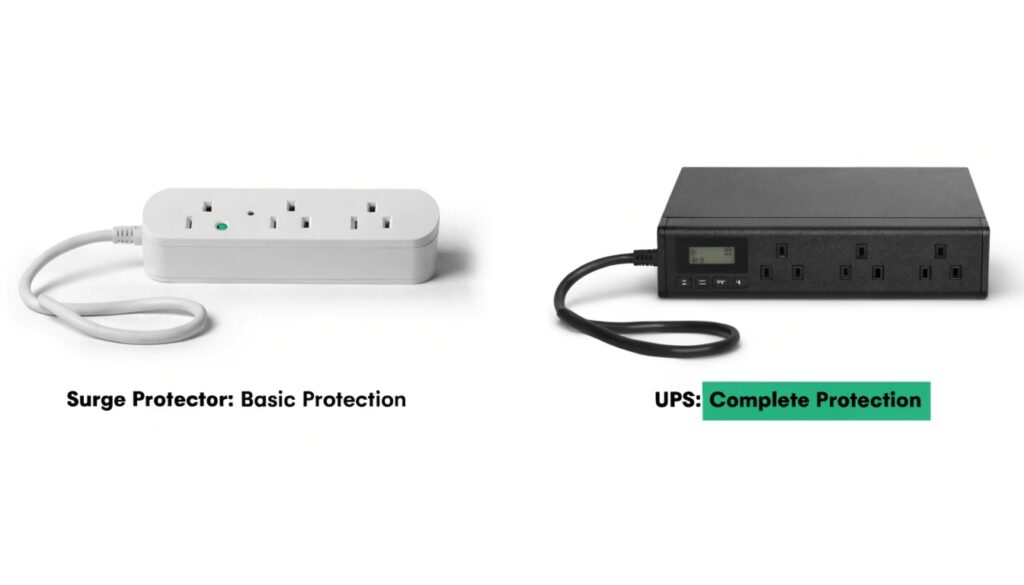
As someone who has spent ten years designing and building uninterruptible power supplies, my favorite insight is that a UPS has many functions. It’s not just a battery. It's a surge protector, a voltage stabilizer, and a power filter all rolled into one device. It's an active bodyguard for your electronics, not just a simple gatekeeper. To really see its value, you need to understand the different levels of protection it can offer, starting with the very best.
What is an Online UPS System and How Does it Work?
You hear about "online" UPS systems for critical servers. They are expensive, and you wonder if they're just a marketing gimmick. You don't know if you're overspending or under-protecting your most valuable assets.
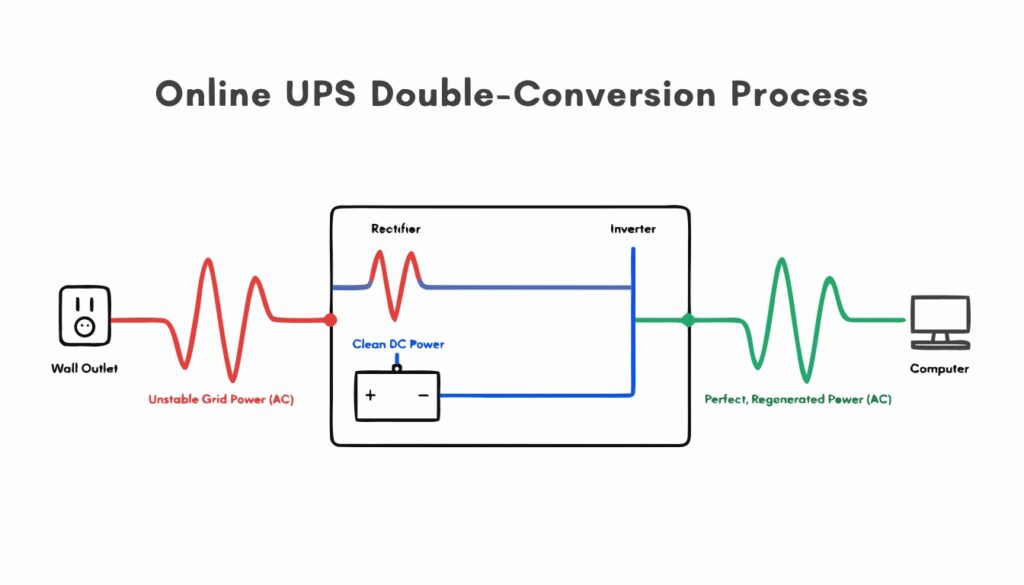
An Online UPS creates a perfect, brand-new power signal for your devices 24/7. It completely isolates your equipment from the grid by constantly converting incoming AC to DC, then back to a new AC signal. This offers the highest level of protection available.
The Ultimate Power Fortress
The secret to an Online UPS is a process called "double-conversion." It takes the dirty, unpredictable AC power from your wall outlet and first converts it into clean DC power, which it uses to charge its battery. Then, it uses power from this clean DC source to run an inverter, which regenerates a completely new, pure, and perfectly stable AC sine wave. Your equipment runs off this regenerated power all the time. It is never directly connected to the raw power grid.
This means there is zero transfer time during a blackout. Because your computer is already running off the inverter, when the grid power fails, the inverter simply continues to run, drawing from the battery instead of the rectifier. There is no switch, no flicker, no gap. This total isolation is why we supply Online UPS systems to hospitals, data centers, and banks. For them, even a millisecond of interruption is not an option.
| UPS Type | Protection Level | Transfer Time | Best For |
|---|---|---|---|
| Online | Maximum | 0 ms | Critical servers, medical equipment |
| Line-Interactive | High | 4-8 ms | PCs, workstations, small servers |
| Standby (Offline) | Basic | 8-10 ms | Home PCs, non-critical devices |
What is the Function of a UPS?
You think of a UPS as just a "battery backup." This simple view makes it hard to justify the cost. You think you're just paying for a heavy box that you'll rarely use.
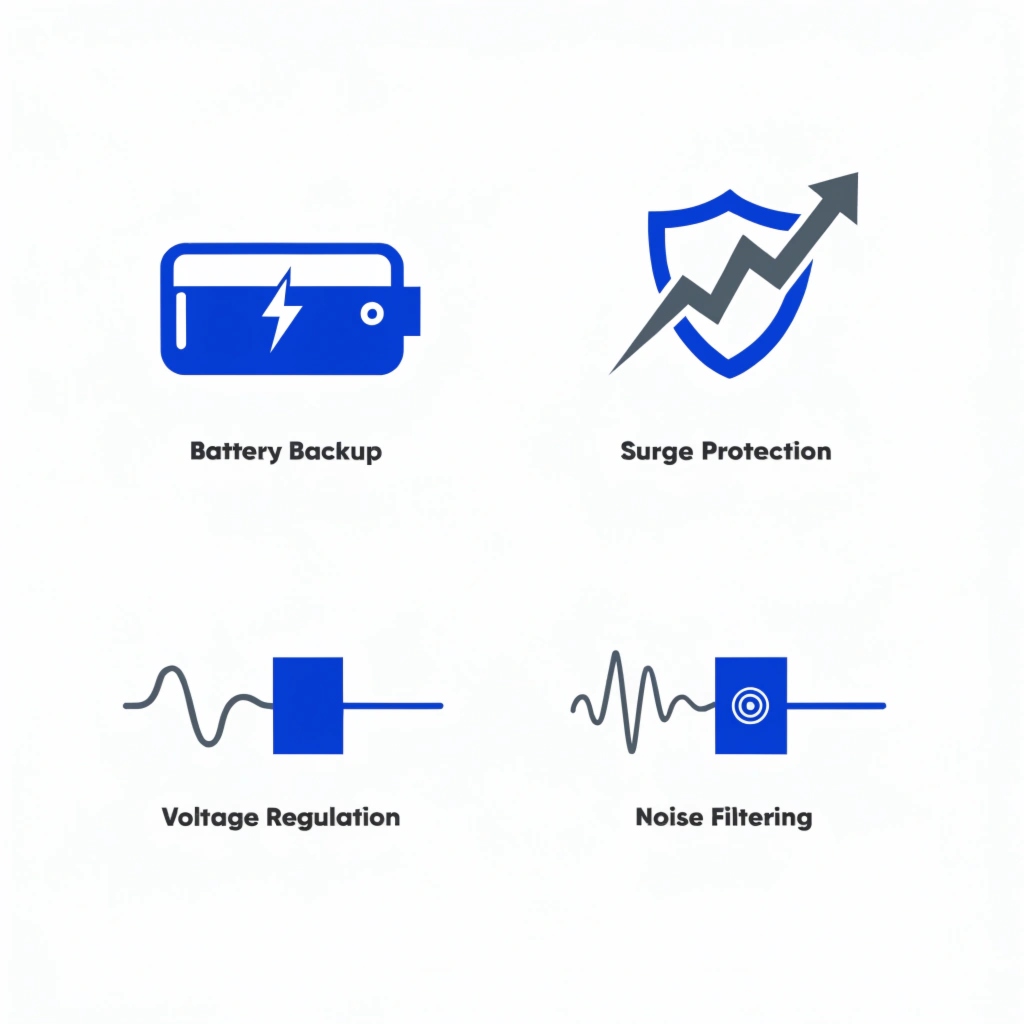
A UPS provides uninterruptible power during an outage. Its other key functions include protecting from power surges, filtering electrical noise, and regulating voltage. It ensures clean and stable power to your devices at all times, not just during blackouts.
More Than Just a Battery
As I've said, a UPS has many functions. Thinking of it as just a battery is like thinking of a smartphone as just a phone. The battery backup is the most famous feature, but it's the other functions that work every day to protect your gear.
- Uninterruptible Power: This is the core function. When a blackout happens, its battery and inverter give you a seamless bridge of power. This allows you to save your work and shut down your system properly, preventing data corruption and hardware stress from a sudden power loss.
- Surge Protection: Every UPS has built-in circuits, usually using components called MOVs (Metal Oxide Varistors), that absorb and divert dangerous voltage spikes caused by lightning or grid problems. This is the one function it shares with a basic surge protector.
- Voltage Regulation: Most modern UPS units (Line-Interactive and Online) have an Automatic Voltage Regulator (AVR). It constantly monitors the input voltage. If it detects a brownout (low voltage) or a swell (high voltage), it corrects the power without using the battery, saving the battery for a true emergency.
- Power Filtering: The UPS also filters out small electrical "noise" (EMI/RFI) that can cause glitches and errors in sensitive electronics.
What is the Difference Between a UPS and a Surge Protector?
You see a surge protector for $20 and a UPS for $150. The price gap is huge, and you wonder if the extra cost is really worth it. You don't want to waste money, but you also don't want to lose your data.
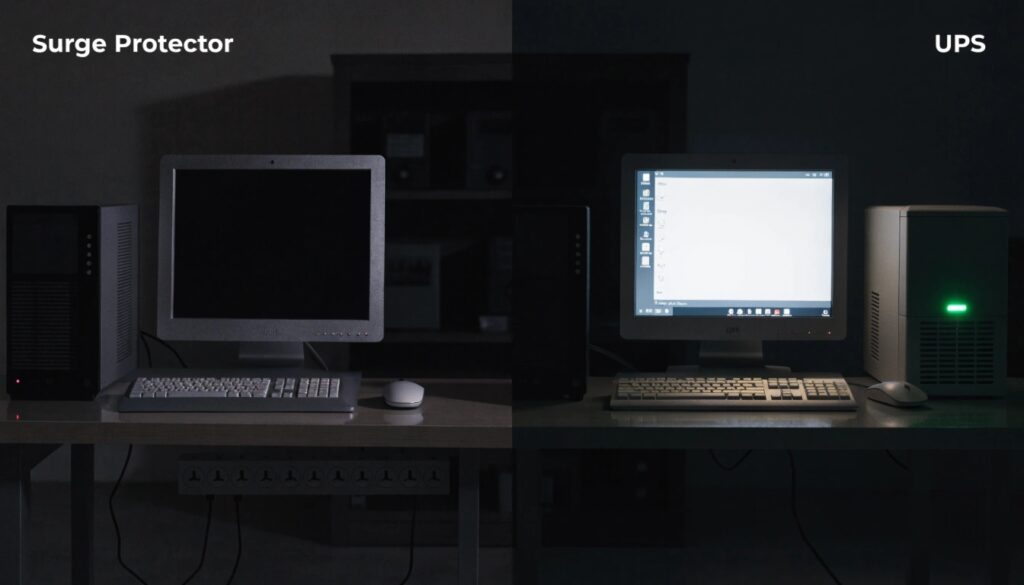
A surge protector only protects against voltage spikes. A UPS does that and contains a battery to provide power during a complete blackout. A surge protector is a passive shield; a UPS is an active defense system that can create its own power.
Protection from Damage vs. Protection from Downtime
The difference comes down to one critical component: an inverter and a battery.
A surge protector is a very simple device. Its only job is to sacrifice itself to protect your equipment from a massive voltage spike. It cannot do anything about low voltage, and it is completely useless during a blackout. When the power goes out, your equipment immediately shuts off. It's a one-trick pony designed to prevent catastrophic damage, not interruption.
A UPS is an active, intelligent device. It also protects from surges, but its main job is to defeat downtime. When a blackout occurs, its battery and inverter work together to create a new source of AC power, keeping your computer running. This gives you time to save your work and shut down safely. A surge protector is like a helmet; it might save you from a single, fatal blow. A UPS is like a bodyguard in a tank; it protects you from all threats, big and small, and keeps you operational.
| Feature | Surge Protector | UPS |
|---|---|---|
| Surge Protection | Yes | Yes |
| Blackout Protection | No | Yes |
| Voltage Regulation | No | Yes (Most models) |
| Primary Goal | Prevent damage | Prevent damage and downtime |
Is a Voltage Stabiliser Needed Along with a UPS?
You have an old voltage stabilizer and a new UPS. You are thinking about plugging the UPS into the stabilizer for "double protection." You hope this will make your setup extra safe, but you're not entirely sure.
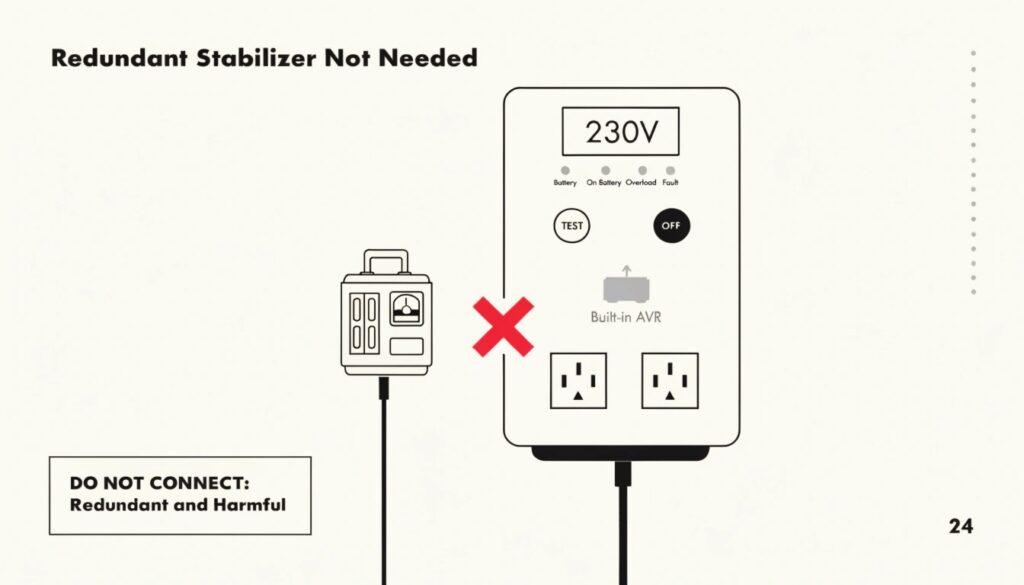
No, a separate voltage stabilizer is not needed and is often harmful when used with a modern UPS. Line-Interactive and Online UPS models already have a faster, more efficient voltage stabilizer built-in, making an external one redundant and potentially problematic.
Two Systems Fighting Each Other
As a manufacturer, I can tell you this is a bad idea. It's one of the most common mistakes I see well-meaning customers make. A modern UPS is already designed to handle voltage fluctuations.
Here's why you shouldn't do it:
- It's Redundant: A Line-Interactive or Online UPS already contains an Automatic Voltage Regulator (AVR). You are simply adding a second, slower, and less efficient device to do a job that is already being done better inside the UPS.
- They Will Conflict: This is the biggest problem. The external stabilizer might sense low voltage and slowly "boost" it. The UPS's internal AVR will see this sudden boost as a power swell and try to "trim" it back down. The two devices will constantly fight each other, causing rapid clicking, energy waste, and unnecessary wear and tear on the UPS's components. You are creating a problem, not solving one.
The only time this might make sense is with the most basic, cheapest Standby UPS that has no internal AVR, but the correct solution in that case is simply to buy a better UPS.
Conclusion
A surge protector offers only basic protection from damage. A UPS is a complete power solution, providing battery backup for outages, superior surge defense, and voltage regulation for total electronic safety.