
You want a UPS with your own brand, but OEM manufacturing seems confusing. Working with many suppliers is a headache, causing bad quality and delays that hurt your business.
To customize a UPS, you find a specialized OEM manufacturer that provides a complete service. This service includes branding, custom technical specs, and production, which simplifies the whole process for you.
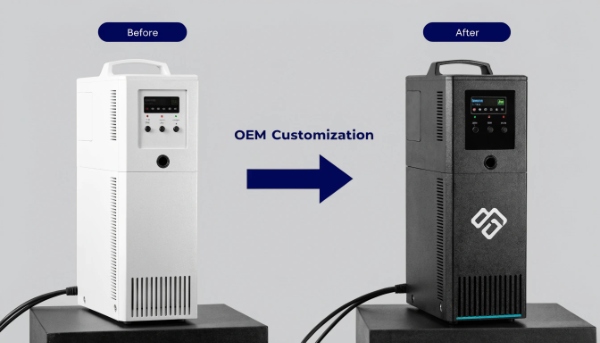
Today, many international clients need to customize uninterruptible power supplies with their own brand. The best way to do this is to find a factory that specializes only in making UPS systems. As a dedicated manufacturer, my company, Daopulse, can provide a complete set of production services to help you create your own branded product. I’ve seen how the right partnership simplifies everything. Let’s look at the questions that come up on this journey.
What Are the Common Questions During OEM Uninterruptible Power Supply Development?
Starting an OEM project feels like a big challenge. You have questions about costs, timelines, and rules, and getting clear answers can be slow and frustrating.
Common OEM questions are about Minimum Order Quantity (MOQ), customization options for voltage and capacity, getting certifications like CE and RoHS, and the project timeline. A good manufacturer provides clear answers upfront.
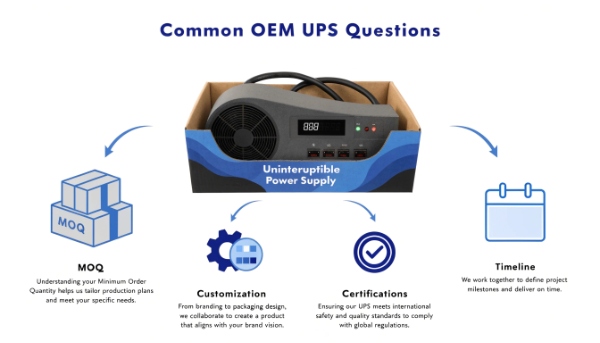
Getting the Answers You Need
Over the last ten years, I've answered these same questions for hundreds of procurement managers. A transparent partner will make this information clear from the very beginning. It's the foundation of a good relationship.
Here are the key areas we discuss with every new client:
1. Minimum Order Quantity (MOQ)
Clients often ask about the minimum number of units they must order. The MOQ exists because sourcing components and setting up the production line is most efficient for a certain batch size. However, we understand you may want to test the market first. That's why we support small-batch trial orders before you commit to full-scale manufacturing.
2. Customization Capabilities
This is where we can really help your brand stand out. Customization isn't just about a logo. It includes:
- Technical Specs: We can tailor the voltage, capacity, and socket types to match your target market.
- Battery Type: We offer both cost-effective lead-acid and high-performance lithium battery solutions.
- Branding: We can print your logo on the unit, design custom packaging, and even modify the color of the case.
3. Certifications and Timeline
"Do your products have CE certification?" This is a critical question. We ensure all our products meet international standards like CE, RoHS, and ISO. Our team manages the certification process so you don't have to. A typical project timeline looks like this:
| Stage | Typical Duration |
|---|---|
| Design and Prototyping | 2-4 Weeks |
| Testing and Certification | 4-6 Weeks |
| Mass Production | 4-8 Weeks |
How Do You Find a Good OEM Manufacturer for an Uninterruptible Power Supply (UPS)?
Choosing the wrong OEM partner is a big risk. It can lead to poor quality, missed deadlines, and communication problems that damage your brand's reputation and your bottom line.
To find a good UPS OEM, check their years of experience and certifications like ISO and CE. Also, make sure they have a good English-speaking team for clear communication and a strong technical department.
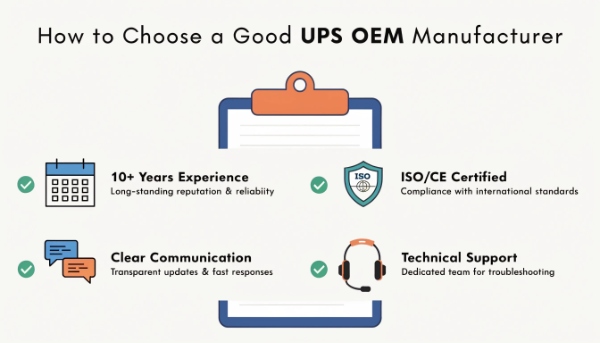
A Checklist for Choosing Your Partner
Finding a manufacturer is easy. Finding a long-term partner is harder. Based on my experience helping clients succeed, here is what you should look for.
1. Proven Experience and Specialization
Ask how long they have been in business. More importantly, ask if they specialize in UPS systems. My company has focused on nothing but UPS technology for over a decade. This deep focus means we understand the product inside and out. We have even developed our own patented technologies.
2. Quality Control and Certifications
This is not negotiable. Ask for copies of their ISO, CE, and RoHS certifications. An ISO certification shows they have a managed, repeatable production process. CE and RoHS are necessary to sell in many international markets. These documents prove a commitment to quality and safety.
3. Strong Communication and Support
Many of our clients are procurement managers like Mr. Li at a hospital infrastructure company. They need clear, timely communication. Does the manufacturer have a dedicated, English-speaking team? When you have a question, you need a quick answer. Our professional team is set up for seamless communication with clients worldwide.
4. Technical Expertise
A good OEM is more than just a factory; they are a technical consultant. They should be able to discuss the pros and cons of lead-acid versus lithium batteries for your specific project. They should help you design the best solution, not just build what you ask for.
How Do You Install an Uninterruptible Power Supply System?
You just received your new UPS, but incorrect installation can damage it or your expensive equipment. The process can seem complex, leading you to make costly mistakes.
To install a UPS, first, inspect it for damage. Place it in a cool, ventilated space. Then, connect your equipment to the UPS. Finally, plug the UPS into the wall outlet and turn it on.
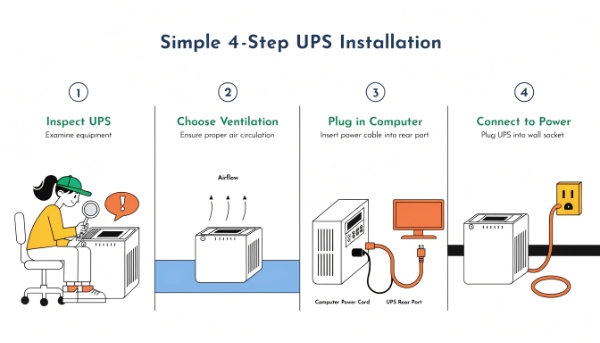
A Safe and Simple Installation Guide
We design our UPS systems to be user-friendly, but following the correct steps is crucial for safety and performance. If you ever run into problems during installation, remember that our professional technical team is here to support you.
Step 1: Check the Location and the Unit
Before you do anything, look at the box and the unit for any signs of damage from shipping. Choose a location for the UPS that is clean, dry, and has good airflow. Heat is the enemy of batteries, so avoid hot closets or direct sunlight.
Step 2: Connect the Battery (If Needed)
For most smaller plug-and-play units, the battery is already connected internally. For larger systems with external battery packs, you will need to connect them. Always follow the manual's diagram.
Step 3: Connect Your Equipment (The Load)
Look at the back of the UPS. You will see outlets marked "Battery Backup + Surge" and some marked "Surge Only." Plug your critical equipment, like your computer and monitor, into the battery backup outlets. Plug less critical devices, like a printer, into the surge-only outlets. Do not overload the UPS.
Step 4: Power It Up
First, plug the UPS itself into the wall outlet. Let the battery charge for at least 8 hours before first use. Then, press the power button on the UPS to turn it on. Finally, you can turn on your computer and other connected devices.
How Do You Check the Battery of an Uninterruptible Power Supply?
Your UPS is supposed to protect you, but a dead battery makes it useless. Waiting for a power outage to discover your battery has failed is a risk you cannot afford.
To check a UPS battery, run a self-test using the button on the unit. For a more accurate check, fully charge it, then unplug the UPS from the wall to see how long it powers your devices.

Two Simple Ways to Test Your Battery
A UPS battery is a consumable part; it will not last forever. Regular checks are essential to ensure your systems are protected. We guide our clients through these simple steps to verify battery health.
1. The Built-in Self-Test
Most modern UPS units have a "Test" button. When you press it, the UPS briefly switches to battery power to simulate an outage. This simple test checks if the battery can take a load. If the UPS beeps and stays on, the battery is likely okay. If it turns off or shows a fault, the battery may need replacement. You should run this test every few months.
2. The Manual Runtime Test
This is the most reliable way to know your battery's true condition.
- Charge it: Make sure the UPS has been plugged in and charging for at least 24 hours.
- Connect a load: Connect a non-critical device, like a desk lamp, that uses about half of the UPS's capacity.
- Unplug it: Unplug the UPS from the wall outlet and start a timer.
- Time it: See how long the UPS powers the lamp.
If the runtime is much shorter than it was when it was new (for example, if it now lasts only 5 minutes instead of 15), it is a clear sign that the battery is weak and should be replaced soon. If you have any questions about this process, our technical team can walk you through it.
Conclusion
Customizing a UPS is easy when you find the right OEM partner. A good manufacturer will guide you from design to installation and maintenance, ensuring a high-quality product for your brand.